Someone just resigned. You're scrambling to backfill. The last thing on your mind is a structured conversation about why they're leaving.
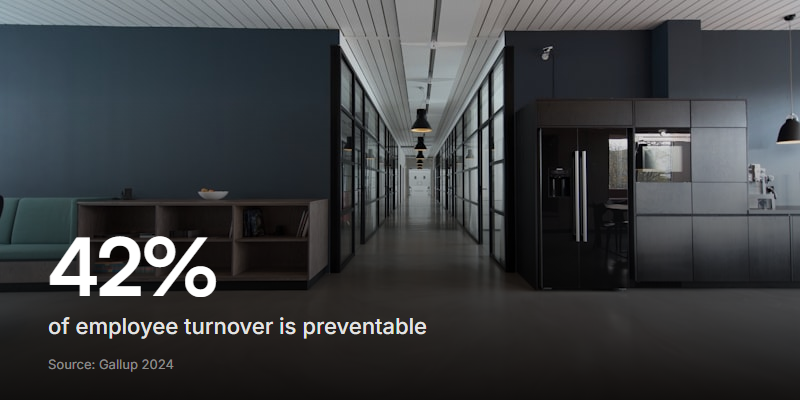
But here's the problem: Gallup research found that 42% of employee turnover is preventable. Nearly half the people who walk out the door didn't have to. The organisation just missed the signals - or never asked the right questions.
Exit interviews are your last chance to find out what went wrong. Not to save the person leaving (usually too late for that), but to stop the next resignation. This guide gives you 30 questions organised by what each one actually uncovers, plus a format that gets people to say what they really think.
Why most exit interviews fail
The standard exit interview is a 15-minute checkbox exercise on someone's last day. HR asks a few polite questions. The departing employee gives polite answers. Everyone moves on.
Three problems with this:
- Timing is wrong. By the final day, people are mentally checked out. They're thinking about their new job, not giving you a detailed post-mortem.
- The format kills honesty. A face-to-face meeting with someone from HR - who the employee may barely know - is not the setting for candid feedback. People soften their answers or skip the hard stuff entirely.
- Nobody acts on it. Even when someone does share something useful, the feedback often dies in a spreadsheet. No follow-up, no pattern analysis, no change.
According to Gallup's workplace research, 36% of employees who voluntarily left didn't discuss their departure with anyone before resigning. They didn't raise concerns. They didn't flag problems. They just left. If your exit interview is the first time you're hearing about an issue, the process that should have caught it earlier already failed.
What a good exit interview actually looks like
A useful exit interview has four things:
- Structure. A consistent set of questions so you can compare answers across departures and spot patterns.
- Privacy. The person needs to feel safe being honest. That might mean a third-party interviewer, an anonymous survey, or an async video format where they record answers alone.
- Timing. Run it 1-2 weeks before the last day - not on the last day itself. People are more willing to share when they're not already mentally gone.
- Follow-through. Someone reads every response. Themes get reported to leadership. Changes happen. Without this, the whole exercise is theatre.
The best exit interviews aren't interrogations. They're structured conversations designed to surface patterns across many departures - not assign blame for one.
30 exit interview questions by category
Not all questions serve the same purpose. Organising them by what they uncover makes it easier to pick the right ones for your situation and spot themes in the answers.
Questions about the role itself
These questions reveal whether the job matched expectations - and where the gap was.
- What did you enjoy most about your role?
- What parts of the job frustrated you the most?
- Did your day-to-day work match what you expected when you accepted the offer?
- Were there skills or strengths you have that you felt were underused?
- If you could redesign this role, what would you change?
The "redesign" question is the most useful one here. It forces people to think constructively rather than just venting, and the answers often reveal fixable problems.
Questions about management
Manager quality is the single biggest factor in whether someone stays or goes. SHRM's 2024 employee benefits survey found that 74% of HR professionals cite compensation as the top reason employees leave - but dig deeper and management issues are almost always intertwined with pay dissatisfaction. People don't leave jobs they love because of a 10% raise elsewhere.
- How would you describe your relationship with your direct manager?
- Did you get enough feedback on your work? Was it useful?
- Did you feel your manager supported your professional development?
- Were there conversations with your manager that could have changed your decision to leave?
- What's one thing your manager could do differently for whoever fills this role?
Question 9 is the one that stings - but it's the most valuable. If the answer is "yes, but they never happened," that's a management coaching opportunity.
Questions about growth and development
People leave when they can't see a future. These questions uncover whether the problem is the career ladder, the learning opportunities, or both.
- Did you feel you had clear opportunities for advancement here?
- Were there training or development programmes you wanted but didn't have access to?
- Did you feel your contributions were recognised appropriately?
- What would have needed to change for you to see a long-term future here?
- How does the role you're moving to compare in terms of growth opportunities?
Question 15 is telling. If someone's leaving for the same title at the same pay but with a clearer growth path, that's a retention problem you can fix.
Questions about culture and team dynamics
Culture problems are hard to spot from the top. The people leaving are often the best source of truth.
- How would you describe the team culture to someone considering joining?
- Did you feel comfortable raising concerns or disagreements?
- Was there a specific event or moment that made you start thinking about leaving?
- How would you rate the work-life balance in your role?
- Did you feel included in decisions that affected your work?
Question 18 is the one most people dodge in person. There's almost always a tipping point - a meeting, a decision, a conversation that shifted someone from "this is fine" to "I'm updating my CV." Getting to that moment is gold.

Questions about compensation and benefits
Money isn't always the reason, but pretending it's never the reason is naive.
- Do you feel your compensation was fair for the work you did?
- Were there benefits or perks that would have made a difference?
- How does your new role compare in terms of total compensation?
Keep these short and direct. People will either tell you about the money or they won't - five different versions of "was the pay okay?" won't change that.
Questions about the organisation
These zoom out from the individual experience to the company level.
- Would you recommend this company as a place to work? Why or why not?
- Did you feel the company's direction was clear and well-communicated?
- Were there company policies or processes that made your job harder than it needed to be?
- How did the reality of working here compare to what you expected when you joined?
The gap between expectation and reality (question 27) often points to employer branding or onboarding problems.
"People don't leave companies. They leave situations." The exit interview's job is to figure out what that situation was - before it happens to the next person.
Forward-looking questions
These help you improve the role for the next person.
- What advice would you give to whoever takes over your role?
- Is there anything we could have done differently that might have changed your decision?
- Would you ever consider coming back? What would need to change?
The "boomerang" question (30) is underrated. If someone says "absolutely, if you fixed X," you've just got a prioritised retention roadmap from someone with nothing to lose by being honest.
How many questions should you ask?
Not all 30. Pick 10-12 that match the situation. If you already know someone's leaving for more money, don't spend half the interview on compensation questions. Focus on culture, management, and growth instead.
The sweet spot is 15-20 minutes. Long enough to get real answers, short enough that people don't start giving one-word responses to get it over with.
| Situation | Focus areas | Suggested questions |
|---|---|---|
| High performer leaving | Growth, management, recognition | 6, 9, 11, 13, 14, 15, 29 |
| Short tenure (under 12 months) | Role fit, onboarding, expectations | 3, 5, 18, 27, 28 |
| Team experiencing multiple exits | Culture, management, inclusion | 16, 17, 18, 20, 25, 26 |
| Senior leader departing | Strategy, communication, direction | 24, 25, 26, 27, 29, 30 |
Why async video gets better exit interview answers
Here's the core tension: exit interviews need honesty, but the format actively discourages it.
Sitting across from an HR person on your last day - someone who might be a reference, who works with your old manager, who represents the company you're leaving - is not the setup for unfiltered feedback. People filter. They soften. They skip the parts that feel too personal or too political.
Work Institute's 2023 Retention Report (cited by SHRM) found that 77% of employees who quit could have been retained. That's a staggering number - and it suggests organisations are systematically missing the signals. Part of the problem is that the signals only come out when people feel safe enough to share them.
Async video interviews flip the dynamic. The departing employee gets a link, opens it on their own time, and records their answers to each question on camera. No one sitting across from them. No pressure to respond in real time. No awkwardness.
This format works for exit interviews because:
- People say more when they're alone. The social pressure of a live conversation disappears. Someone who'd say "my manager was fine" in person will explain what "fine" actually means on a solo recording.
- You capture tone and emotion. Unlike a text survey, video shows you how someone feels about their answer. A flat "everything was great" with crossed arms tells a different story than the words alone.
- It's easier to spot patterns. When you have 20 video exit interviews, you can watch them back-to-back and see the same themes emerge. That's much harder with a pile of written notes from different interviewers.
- Scheduling disappears. No calendar coordination needed. The employee records when it suits them - could be their commute home, could be the weekend before their last day. You review when you're ready.
If you're running employee engagement surveys alongside exit interviews, the video format creates a consistent feedback channel that captures what written forms miss.
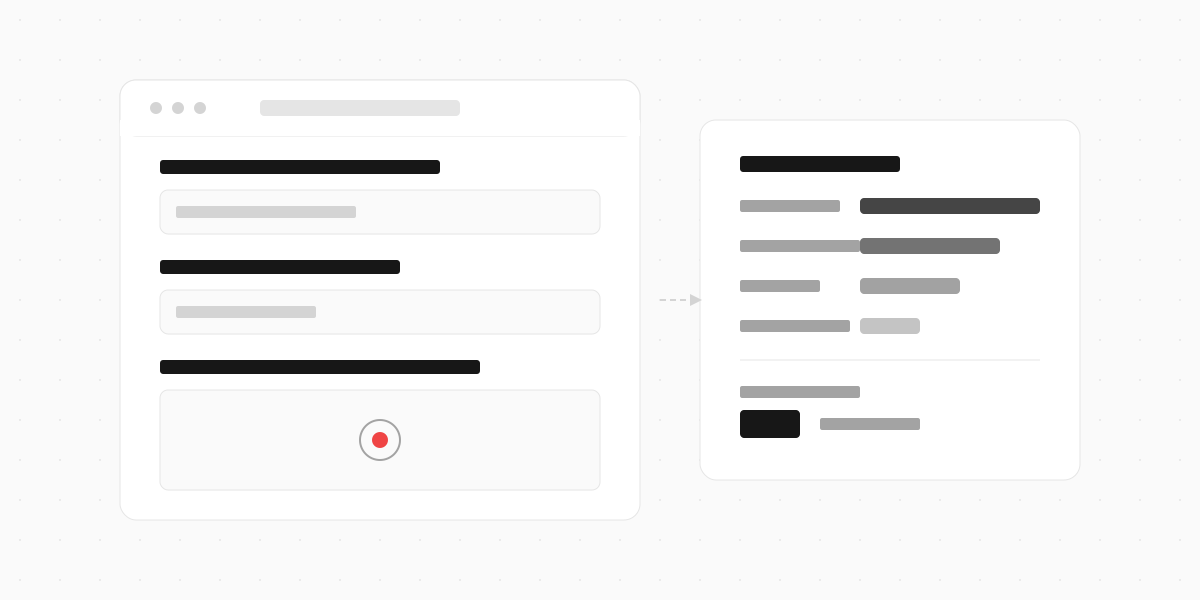
With a tool like Clipform, you can set up an exit interview as a video-first form: record a short video prompt for each question (your head of HR asking it on camera), share a single link, and let the departing employee record their answers whenever they're ready. Responses come back with auto-transcription, so you get both the raw video and a searchable text version.
Async doesn't mean impersonal. Recording a video prompt of a real person asking each question makes the experience feel more human than a typed survey - while still giving the respondent the privacy to answer honestly.
How to use exit interview data
Collecting answers is the easy part. Making them useful is where most organisations fail.
Tag and categorise every response. Build a simple taxonomy: management, compensation, growth, culture, role fit, work-life balance. Tag each answer so you can filter and count.
Look for patterns, not outliers. One person complaining about the office temperature is noise. Five people in the same team mentioning a lack of feedback is a signal. You need at least 10-15 exit interviews before patterns become reliable.
Report themes quarterly. Aggregate the data and share it with leadership. "In Q1, 60% of voluntary leavers cited unclear growth paths" is actionable. A folder of individual exit interview notes is not.
Close the loop. When exit interview data leads to a change - a new feedback process, a revised comp structure, a management training programme - say so publicly. It signals that the organisation listens, which improves the quality of future exit interviews. It also helps with current employee engagement.
| Action | Frequency | Owner |
|---|---|---|
| Tag and categorise responses | After each exit interview | HR / People Ops |
| Review patterns and flag themes | Monthly | HR lead |
| Report to leadership with recommendations | Quarterly | Head of People |
| Communicate changes made from feedback | Quarterly | Internal comms |
Exit interview template
Here's a ready-to-use template you can adapt. Pick 10-12 questions from the list above and structure them in this order:
- Warm-up (questions 1-2) - start with positives to set a constructive tone
- Role and expectations (questions 3-5) - establish the gap between expectations and reality
- Management and support (questions 6-10) - the hardest section, so it comes after they're warmed up
- Growth and recognition (questions 11-14) - forward-looking, less confrontational
- Culture and team (questions 16-18) - broad enough to surface unexpected issues
- Looking ahead (questions 28-30) - end on a constructive note
If you're using an async video format, each section becomes a recorded prompt. Keep video prompts under 30 seconds each - ask the question, add a brief "why we're asking" line, and let the person respond.
Turn exits into retention data
Every exit interview is a data point. One tells you why a specific person left. Twenty tell you why people leave. The difference between organisations that retain talent and those that watch it walk out the door isn't budget or benefits - it's whether they systematically listen and act.
The 42% preventable turnover stat from Gallup isn't theoretical. It means that for roughly every two people who leave, one of them didn't have to. The exit interview is your best tool for figuring out which problems to fix first - but only if the format encourages honesty and someone actually reads the answers.
Start with 10 questions from this list, run them async so people feel safe being real, and review the patterns quarterly. The answers are there. You just have to make it easy enough for people to give them.