
A 360 feedback form gathers feedback on one person from everyone around them: their manager, their peers, the people who report to them, and themselves. The "360" is the full circle. Instead of one boss's opinion once a year, you get a rounded picture from the people who actually see the work.
That's the theory. In practice, most 360 forms collect polite, hedged ratings that nobody fully trusts.
This guide covers how to build a 360 feedback form that gets honest, specific answers - the questions to ask each rater group, a template you can copy, and why the answer format matters more than most people think.
What is a 360 feedback form?
It's a structured questionnaire used to review one employee from multiple perspectives at once. Each rater answers the same core questions about that person, usually anonymously, and the results get combined into a single picture.
A typical 360 pulls from four groups:
- The manager - the traditional top-down view
- Peers - colleagues who work alongside the person day to day
- Direct reports - the people the person manages (if they manage anyone)
- Self - the person rates themselves, so you can compare how they see their own work against how others do
That last comparison is the whole point. The gap between someone's self-rating and everyone else's is often the single most useful thing a 360 surfaces. Someone who rates their own communication a 9 while their team rates it a 4 has a blind spot worth a conversation.

Why most 360 feedback fails
Here's the uncomfortable part. A lot of employees don't believe in 360s at all.
In a LiveCareer survey of 1,000 workers reported by SHRM, 79% said they'd opt out of 360-degree reviews if they could, and 74% felt the results were unfair, biased, or inaccurate. Nearly half said the process amplifies office politics rather than giving an honest read.

That skepticism isn't irrational. It comes from forms that get three things wrong.
They're all numbers, no context. A grid of 1-to-5 ratings tells you someone scored 3.2 on "collaboration." It doesn't tell you why, or what they should do differently. A score without a reason isn't feedback. It's a grade.
They feel anonymous but aren't. On a team of six, a "confidential" comment about the only person in a particular role isn't confidential at all. People know this, so they soften everything. Same problem that breaks anonymous feedback forms in general.
Nothing happens afterwards. When a review goes into a folder and never turns into a conversation, people learn it's theatre. The next round, they phone it in.
Fix those three and a 360 becomes genuinely useful. Get them wrong and you've just run a popularity contest with a spreadsheet.
The best 360 feedback questions
Good 360 questions are specific, behaviour-based, and answerable by someone who isn't the person's manager. Avoid anything that needs inside knowledge only a boss would have ("is their work aligned to department OKRs?"). Peers and reports can't answer that honestly, so they guess.
Organise questions by competency. It keeps raters in one mindset and makes the results easier to read.
Communication
| Question | What it surfaces |
|---|---|
| How clearly does this person explain their thinking, even when the topic is complex? | Clarity, not just talkativeness |
| When they disagree with you, how do they handle it? | Conflict style, directness |
| Do they keep the people who need to know in the loop? | Proactive communication |
Collaboration and teamwork
| Question | What it surfaces |
|---|---|
| When the team is under pressure, what do they do? | Behaviour under stress, not stated values |
| Can you count on them to follow through on what they commit to? | Reliability |
| Is there something they do that makes your job harder? | Specific friction, the most actionable answer you'll get |
Leadership (for anyone who manages people)
| Question | What it surfaces |
|---|---|
| Does this person give you feedback that actually helps you improve? | Coaching quality, not frequency |
| When you raise a problem, do you feel it gets taken seriously? | Psychological safety on their team |
| Do they give credit where it's due? | Whether people feel seen |
Growth and self-awareness
| Question | What it surfaces |
|---|---|
| Where has this person grown the most over the last year? | Trajectory, momentum |
| What's one thing you'd love to see them work on? | A constructive, forward-looking ask |
Notice how many of these are open questions, not rating scales. That's deliberate, and it's where most forms leave the real value on the table.
Ratings tell you what. Open answers tell you why
A rating scale is fast to fill in and easy to chart. That's its appeal, and also its limit. "3 out of 5 on leadership" averaged across eight raters gives you a tidy number and almost nothing to act on.
The useful stuff lives in the open-ended answers - the specific example, the bit of context, the thing one peer noticed that nobody else mentioned. So a strong 360 form pairs a few ratings (quick, scannable, good for tracking over time) with open questions that ask for the why.
The catch: people hate typing long answers into a box. They compress three thoughts into one safe sentence and move on. You end up with "great team player" instead of the story that actually helps.
Why video changes what people share
This is the part worth testing. When you ask someone to record a short spoken answer instead of typing one, they tend to say more, and say it more honestly. Talking is faster than typing, so the detail they wouldn't bother writing, they'll happily say out loud.
There's a tone factor too. A typed "needs to work on delegation" lands cold. The same point said out loud, with a "look, I really rate them, but..." carries the warmth that keeps feedback constructive instead of cutting.
This is the gap Clipform is built for. Each question is a short video prompt - you or a team lead on camera, asking it in plain language - and the rater replies however they're comfortable: video, voice, or text. Every spoken answer gets transcribed automatically, so you can read and search the responses without sitting through every clip.
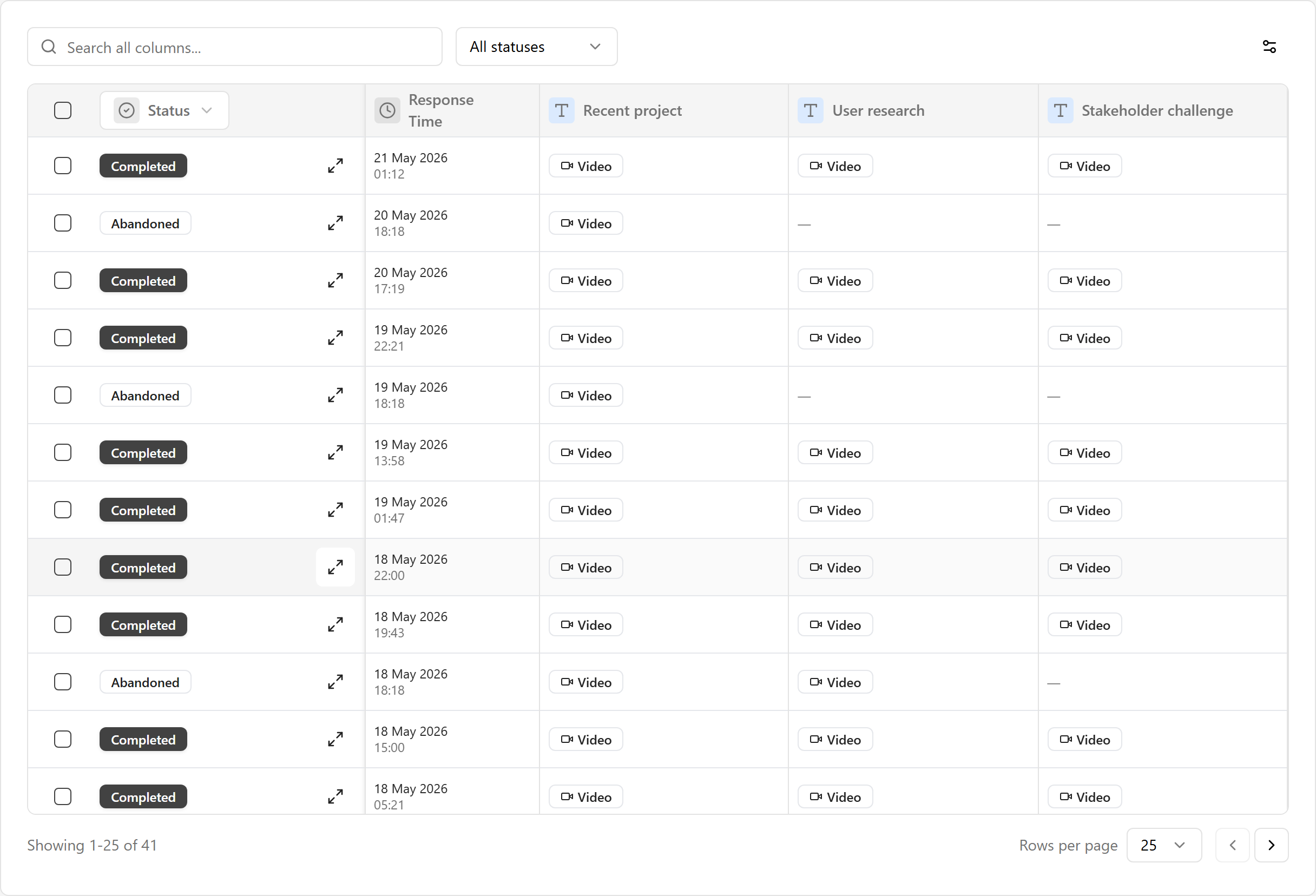
It won't replace your rating scales, and it shouldn't. For the quick "rate this 1-5" questions you want for trend tracking, a normal multiple-choice question is perfect. But for the two or three questions where the real insight lives - "what should they keep doing", "what's one thing to work on" - video pulls answers a text box never will. You can read more on why video responses beat text forms for any feedback that needs nuance.
A simple 360 feedback template
Here's a 10-question form you can run this week. It works for most individual contributors and managers, and takes a rater about five minutes.
| # | Competency | Question | Format |
|---|---|---|---|
| 1 | Communication | How clearly does this person communicate, even on complex topics? | Scale 1-5 |
| 2 | Communication | Give an example of when they communicated something really well, or really badly. | Open / video |
| 3 | Collaboration | How reliably do they follow through on commitments? | Scale 1-5 |
| 4 | Collaboration | Is there something they do that unintentionally makes your work harder? | Open / video |
| 5 | Leadership | Do they give feedback that helps you improve? (Skip if not applicable.) | Scale 1-5 |
| 6 | Leadership | When you've raised a problem with them, what happened? | Open / video |
| 7 | Impact | What's the most valuable thing this person brings to the team? | Open / video |
| 8 | Growth | What's one thing you'd love to see them work on next? | Open / video |
| 9 | Overall | How much do you enjoy working with this person? | Scale 1-5 |
| 10 | Overall | Anything else you think they should hear? | Open / video |
Keep the open questions genuinely open. Don't add sub-prompts or examples - they nudge people toward the answer you expect instead of the one you need.
Send the same form to every rater group and let the relationship (manager, peer, report) be a field they pick at the start. One form to build, one set of results to read, and you can still slice the responses by group afterwards.
How to build the form
You don't need dedicated 360 software to run a good one. Any form builder that handles a mix of rating and open questions will do. The setup is the same either way:
- Write your questions by competency, keeping the form to 8-12 items so raters finish it.
- Pick your raters - aim for at least three per group so no single voice dominates and individual answers stay harder to identify.
- Decide on anonymity and be honest about its limits on small teams. Tell raters how their answers will be reported before they start.
- Set a deadline of about a week. Longer and people forget; shorter and they rush.
- Share the results in a conversation, not a PDF. The form gathers the input - the value comes from what you do with it.

If you want the open questions answered on camera, you can build the whole thing on Clipform in about five minutes. Record your prompts, send one link, and raters reply with video, voice, or text - no app to install and no account to create on their end. The same approach works for stay interviews and exit surveys, where honesty matters just as much.
FAQ
What is a 360 degree feedback form?
It's a questionnaire that collects feedback on one employee from several perspectives at once - their manager, peers, direct reports, and themselves. Everyone answers the same core questions, usually anonymously, and the results are combined into a single view. The aim is a rounded picture rather than one manager's opinion.
How many questions should a 360 feedback form have?
Aim for 8 to 12. That's enough to cover the main competencies without causing fatigue, and it keeps the form under about five minutes per rater. If you need to go deeper, run two shorter rounds across the year rather than one long form people rush through.
Should 360 feedback be anonymous?
Usually yes - anonymity gets you more candid answers. But be honest about its limits. On a small team, the only person in a given role can often be identified from their answers, so soften your promises and aggregate results by group rather than showing individual responses.
Who should be included as raters in a 360 review?
A mix of the person's manager, three or more peers, and (if they manage people) three or more direct reports, plus the person's own self-assessment. Three per group is a good floor - it keeps any single voice from dominating and makes individual answers harder to pinpoint.
How often should you run 360 feedback?
Once or twice a year is plenty for a full 360 - it's a heavier process than a quick pulse survey. Many teams now run a lighter check-in more often and save the full circle for an annual or twice-yearly development conversation. Run it as often as you're genuinely prepared to act on the results.
What's the difference between 360 feedback and a performance review?
A performance review is usually top-down: a manager assesses an employee, often tied to pay or promotion. 360 feedback is multi-directional and built for development, not ranking. The best practice is to keep them separate - when 360 input feeds directly into compensation, raters get cautious and the honesty drops.
Run one that people actually trust
A 360 feedback form is only as good as the answers it gets back. The questions matter, the anonymity matters, and what you do with the results matters most of all. But the quiet lever most teams miss is the format: a wall of rating scales gets you tidy numbers, while a couple of well-placed open questions get you the truth.
If your last round of feedback felt thin, change one thing before you change the questions. Swap two or three rating items for open answers, let people record them instead of typing, and see how much more you hear back.
You can build a 360 form like that on Clipform for free and have it ready to send this afternoon. Start with the 10-question template above, point each question at video or text, and run your most honest review yet.