A quiz funnel is a marketing funnel that starts with a quiz instead of a landing page. Someone takes a short quiz, gets a personalised result, and gives you their email in exchange. It sounds simple. The conversion rates say it's wildly effective.
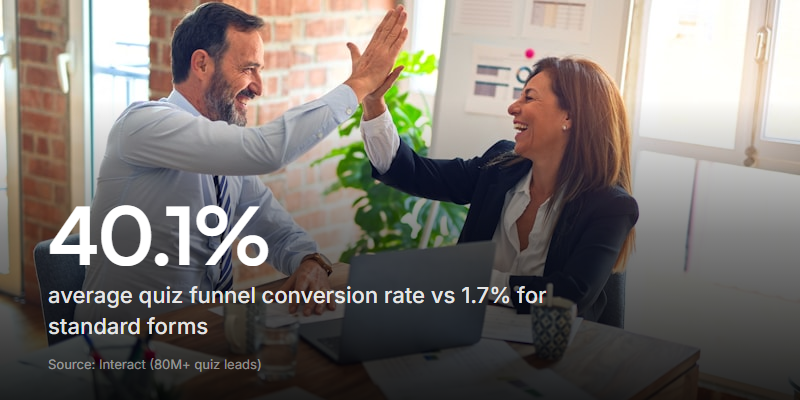
According to Interact (who've powered over 80 million quiz leads), the average quiz funnel converts at 40.1%. Compare that to the 1.7% average for standard forms, and the gap is staggering. People don't want to fill in forms. They do want to find out something about themselves.
This guide covers how quiz funnels work, what types convert best, how to build one, and why adding video takes the format even further.
How a quiz funnel works
The structure is straightforward:
-
Hook. A question or headline that makes someone curious enough to start. "What type of marketer are you?" or "Which skincare routine fits your skin?" The hook has to promise something personal.
-
Questions. 5-10 questions, each one feeling like progress toward the result. Short, visual, one-at-a-time. The best quizzes feel like a conversational form, not a survey.
-
Lead gate. After the last question, before the result: "Enter your email to see your personalised results." This is where the conversion happens. The person is invested - they've answered questions, they want the payoff. (It's the same psychology that makes a good lead capture form ask for contact details last, not first.)
-
Results page. A personalised outcome based on their answers. This could be a personality type, a product recommendation, a score, or a diagnosis. The more specific and useful the result, the more likely they are to share it - and to buy.
-
Follow-up. An email sequence tailored to their result. Someone who scored "advanced" gets different content than someone who scored "beginner." This is where the quiz funnel pays for itself.
The lead gate works because of commitment bias. After answering 7 questions, people feel invested. Abandoning before the result feels like wasted effort. That's why quiz funnels convert at 40% while static forms convert at 2%.
Types of quiz funnels
Personality / type quiz
"What kind of [X] are you?" - the classic BuzzFeed format. Categories like "The Strategist," "The Creator," "The Analyst." Works for any audience that wants to understand themselves better.
Best for: coaching businesses, personal brands, B2B services where segmentation matters.
Example: A marketing agency runs "What's your marketing blind spot?" Quiz results segment leads into "brand-heavy," "data-driven," or "content-first" buckets. Each gets a tailored email sequence and a relevant case study.
Product recommendation quiz
"Which [product] is right for you?" Asks about preferences, needs, budget, and constraints, then recommends the best option. This is the Shopify quiz funnel - and it's a high-value keyword for a reason (retailers pay up to $94 CPC for "shopify quiz funnel" ads).
Best for: e-commerce, SaaS with multiple plans, any business with a product range.
Example: A skincare brand asks about skin type, concerns, budget, and routine complexity. The result page shows 3 recommended products with direct add-to-cart buttons.
Assessment / scorecard quiz
"How good is your [X]?" Grades the user across several dimensions and gives them a score. Creates urgency ("you scored 4/10 on email marketing") and positions your product as the solution.
Best for: B2B SaaS, consulting, agencies.
Example: A CRM company runs "How healthy is your sales pipeline?" Users score 1-10 across five categories. Anyone scoring below 6 gets a demo CTA. Anyone above gets an advanced tips guide.
Knowledge quiz
"How much do you know about [X]?" Tests understanding, then educates on the gaps. Builds authority while capturing leads.
Best for: education platforms, course creators, thought leadership.
Building a quiz funnel that converts
Start with the result, not the questions
Most people build quiz funnels backwards. They start writing questions and figure out the results later. This creates quizzes that feel random and results that feel generic.
Start with 3-5 result buckets. Define exactly what each result means, what content/product it maps to, and what the follow-up sequence looks like. Then write questions that reliably sort people into those buckets. Once the buckets are set, an AI quiz generator can draft those sorting questions from a prompt in seconds.
Question design
Keep questions short. One sentence max. If you need a paragraph to explain the question, it's too complicated.
Use images where possible. Visual choices ("pick the design you prefer") are faster and more engaging than text options.
Make every question feel relevant. If a question doesn't clearly connect to the promised result, cut it. People notice when you're padding.
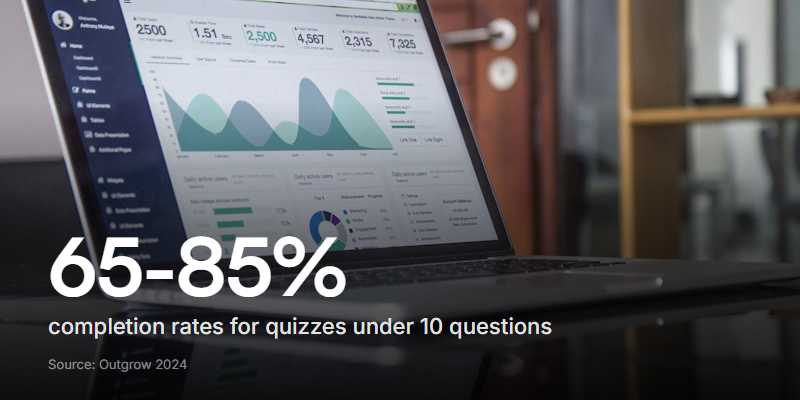
Aim for 5-8 questions. Outgrow's research suggests 65-85% completion rates for short quizzes (3-7 questions). Every question beyond 10 drops completion sharply.
The email gate
Place the email capture after the last question, before the result. At this point, the user is maximally invested.
What to say: "Enter your email to get your personalised results (plus a guide tailored to your type)." The added value (the guide) sweetens the exchange.
What not to do: Don't ask for phone number, company name, or job title at this stage. One field. Email only. You can ask for more later in the follow-up sequence.
The results page
This is where most quiz funnels fall apart. A vague, one-paragraph result wastes all the goodwill the quiz built.
Good results are specific. "You're a Visual Strategist - you learn by seeing, process information spatially, and work best with frameworks. Here's what that means for your marketing..."
Good results are actionable. They include a next step: "Based on your score, here are the three things to fix first" or "Your skin type responds best to these three ingredients."
Good results are shareable. If someone is proud of (or entertained by) their result, they'll post it. That's free distribution. Make the result page visually clean with a clear "Share your result" option.
Video quiz funnels: the next evolution
Here's what nobody in the quiz funnel space is doing yet: video.
Think about it. A quiz already outperforms static forms because it's interactive and personal. Video makes it more interactive and more personal.
Video questions instead of text. Instead of reading a question on screen, you watch someone ask it. A real face, a real voice, a follow-up comment that adds personality. Wyzowl's 2026 report found that 85% of people have been convinced to buy a product or service by watching a video. Wrapping that video around a quiz format amplifies both effects.
Video responses. Instead of picking option A/B/C, the user records a short answer. This turns a simple quiz into a rich qualification tool. You're not just sorting leads into buckets - you're hearing them explain their situation in their own words.
Personalised video results. A pre-recorded video for each result type: "You're a Visual Strategist - here's what that means and what to do next." Video results feel more valuable than text results, and they're harder to ignore.
With Clipform, you can build a video quiz funnel by combining multiple-choice nodes (the quiz questions), video prompts (you asking each question on camera), and open-ended nodes (letting users record video responses). The lead gate sits before the end screen, and results can include personalised video. No code, no downloads - just a shareable link. The geography quiz template and the flag quiz are working examples you can play and clone.
Animoto's State of Video 2026 report found that 78% of consumers trust brands more when they see real-people video. A quiz funnel fronted by a real person builds trust at every step.
Shopify quiz funnels
If you sell products online, quiz funnels are one of the highest-ROI tools available. Platforms like Interact, Octane AI, and RevenueHunt have built their entire businesses around Shopify quiz funnels.
The format for e-commerce is simple:
- Ask about preferences (style, budget, skin type, use case)
- Capture email
- Show 2-3 product recommendations with direct checkout links
- Send an email sequence with the recommendations plus related content
The numbers work because the quiz pre-qualifies the buyer. Instead of browsing 200 products, they see three that match their answers. Decision fatigue drops. Conversion goes up.
Measuring quiz funnel performance
| Metric | Good benchmark | How to improve |
|---|---|---|
| Start rate | 30-50% of page visitors | Better hook, clearer value promise |
| Completion rate | 65-85% | Fewer questions, progress indicator |
| Email capture rate | 35-50% of completions | Stronger value exchange, one field only |
| Result share rate | 5-15% | Better result copy, visual result cards |
| Email-to-purchase rate | 5-15% of captured leads | Better segmented follow-up sequences |
Track each step of the funnel separately. If your start rate is high but completion drops at question 5, that question is the problem. If capture rate is low, the email gate copy needs work.
How to convert quiz leads into sales
A high capture rate is only half the story. The reason quiz funnel lead generation beats a plain form isn't just that more people opt in - it's that every quiz funnel lead arrives pre-qualified. By the time someone hits your email gate, they've told you their skin type, their budget, their team size, or their biggest problem. A static form captures a name and an email. A quiz captures intent.
That intent is what lets you convert quiz leads to sales instead of just adding them to a list. Here's how the back half of the funnel actually earns its keep:
Qualify as you go. Treat each answer as a data point, not just a routing rule for the result page. Budget, urgency, use case, and current tooling all tell you how ready a lead is to buy. A quiz that asks "how are you handling this today?" separates the people who need a demo tomorrow from the ones who are three months out - so your follow-up matches where they actually are.
Route by result, not by list. Someone who scored "advanced" needs a different message than someone who scored "just getting started." Sending both the same generic welcome email wastes the qualification the quiz just did for you. Map each result bucket to its own follow-up: the high-intent buckets get a direct offer or a booking link, the early-stage buckets get education first. This is the same principle behind a well-built lead capture form - qualify first, then ask for the sale when the timing fits.
Nurture with segmented follow-up. Segmentation is where quiz data pays off. Mailchimp's analysis of roughly 11,000 campaigns found that segmented email campaigns get 14.31% higher opens and 100.95% higher clicks than non-segmented ones. A quiz funnel hands you that segmentation on day one - you already know exactly which bucket each lead belongs in, so your nurture sequence can speak to their specific answer instead of a lowest-common-denominator broadcast.
Close on the results page where you can. For e-commerce especially, the fastest path from quiz lead to sale is not an email at all - it's the result itself. A product recommendation quiz can put two or three matched items in front of a shopper with an add-to-cart button right there, while their intent is still hot. The email sequence then becomes the recovery layer for anyone who didn't buy on the spot.
Video sharpens every step of this. When a lead records a short answer instead of ticking a box, you're not just sorting them into a bucket - you're hearing them describe their situation in their own words, which is far richer qualification than any multiple-choice option. And a personalised video result ("here's what your score means and the one thing to fix first") converts warmer than a wall of text, because it feels like a real recommendation rather than an automated payoff.
The through-line: quiz funnel leads convert to sales because the quiz does the qualifying work up front. Capture the intent, route on it, and follow up on it - and the format keeps earning long after the opt-in.
Build your first quiz funnel this week
You don't need a 20-question masterpiece. Start with one goal, one audience, and five questions. Define three result buckets. Write a result page for each. Add an email gate. Launch it.
The 40% conversion rate isn't magic. It's the natural result of asking people to do something they actually enjoy (take a quiz) instead of something they dread (fill in a form). Meet your audience where the motivation already is, and the conversions follow.
See how marketers use Clipform to build quiz funnels, lead capture forms, and video campaigns without waiting on a dev team.