Every open house you run is a lead generation event. But the sign-in sheet sitting on your entryway table determines whether you walk away with 20 usable contacts or 20 illegible scrawls and fake email addresses.
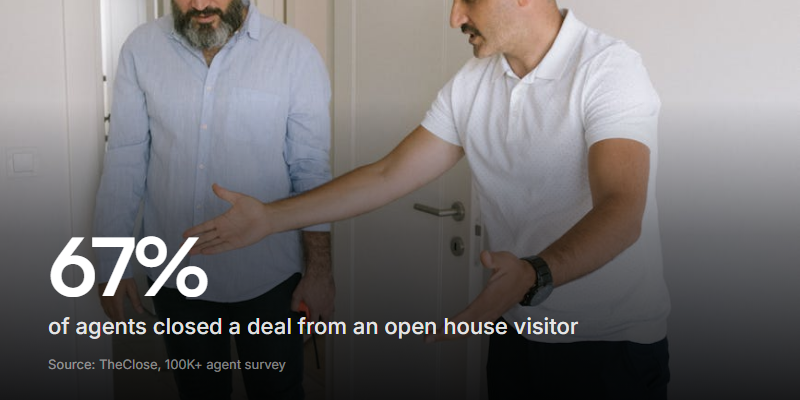
An open house sign-in sheet captures visitor contact information - name, phone, email - so you can follow up after the event. According to TheClose's survey of over 100,000 agents, 67% have closed a buyer or seller they first met at an open house. The sign-in sheet is where that relationship starts.
The difference between a good sign-in sheet and a bad one is usually the same: too many fields, no reason for visitors to give real information, and no plan for what happens next. Get it right, and each open house becomes a predictable source of buyer and seller leads.
This guide covers what fields actually matter, what to leave off, how to get more visitors to fill it in honestly, and whether you should still be using paper at all in 2026.
What to include on your open house sign-in sheet
Keep it short. Every field you add gives visitors another reason to skip yours entirely. Here's what actually earns its place:
The essentials (non-negotiable)
- Full name - first and last. You need both for CRM lookups and follow-up emails that don't feel generic
- Email address - your primary follow-up channel. This is the one field you absolutely cannot lose
- Phone number - with a "text OK?" checkbox. Texting converts faster than email for real estate follow-ups
The qualifier (pick one)
One qualifying question tells you whether this visitor is a hot lead, a warm prospect, or a neighbour who wandered in:
- "Are you working with an agent?" - the classic. Tom Ferry calls this the single most important qualifier because it immediately separates prospects you can work with from those already committed elsewhere
- "What brings you here today?" - options: actively buying, thinking about selling, just browsing. Less direct, but captures seller leads too
Don't include both. One qualifier gets answered. Two get skipped.
Optional (if your sheet still fits one line per entry)
- Neighbourhood or zip code they're searching - useful for matching them to other listings
- Timeline - within 3 months, 6 months, just looking. Helps you prioritise follow-up speed
That's it. Five to six fields maximum. Anything beyond this and completion rates drop fast.
What NOT to include
These show up on sign-in sheets constantly and actively hurt your capture rate:
Home address. Nobody writes their current address on a sign-in sheet at someone else's open house. It feels invasive and offers no value to them. You'll get fake data or blanks.
Budget or pre-approval status. Too personal for a first interaction. Ask this in your follow-up call, not on a piece of paper other visitors can see.
"How did you hear about this open house?" - useful data, wrong place. Visitors don't care about your marketing attribution. If you need this, ask in your follow-up email where the question feels more natural.
Multiple-choice grids or checkboxes about property preferences. This turns your sign-in into a survey. Visitors came to see the property, not fill in forms. Save detailed preference questions for the follow-up conversation.
The golden rule: if a field takes more than 3 seconds to answer, it doesn't belong on a sign-in sheet. You have roughly 15 seconds of visitor goodwill. Spend them on the fields that actually help you follow up.
Paper vs digital: making the right choice
This isn't a binary decision in 2026. Both have a place - the question is which one fits your market, your tech comfort, and your visitors.
When paper still works
Paper sign-in sheets have one advantage that digital can't match: low friction for the visitor. No app to download, no QR code to scan, no loading screens. A clipboard and a pen work with zero Wi-Fi, zero battery life, and zero confusion for visitors of any age.
Real estate coach Stephanie Younger ran 480 open houses and still preferred paper, noting that many visitors feel more comfortable with a physical page. Defences go down. The pen is already in their hand.
Paper works best when:
- Your market skews older (repeat buyers now average age 62, according to NAR's 2025 Profile of Home Buyers and Sellers)
- You're in an area with patchy cell service or weak Wi-Fi
- You run high-volume open houses where speed matters more than data quality
- You already have a fast manual-to-CRM workflow
Paper's real costs:
- Illegible handwriting makes a significant chunk of contact data unusable. Ask any agent who's squinted at a phone number trying to figure out if that's a 7 or a 1
- No validation means fake emails slip through unchecked (visitor@gmail.com, anyone?)
- Manual data entry into your CRM eats 20-30 minutes after each open house
- You can't trigger automated follow-ups until that manual entry is done
When digital is the clear winner
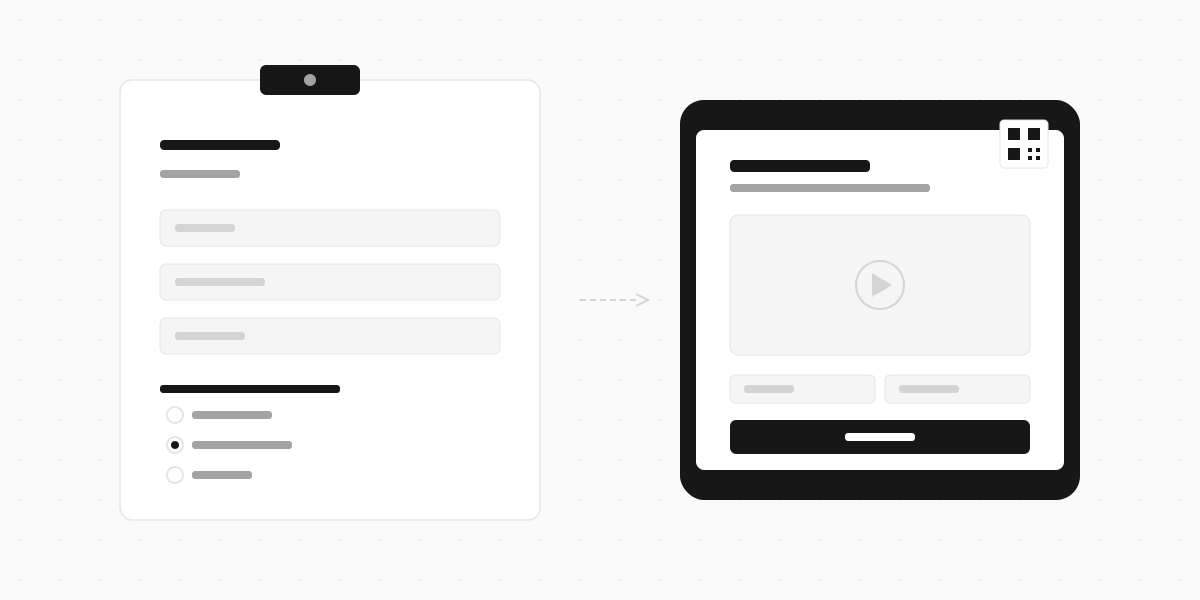
A digital sign-in (tablet at the door, QR code to a mobile form, or both) solves paper's biggest problems: validation, speed, and automation.
Digital works best when:
- You want instant CRM sync and automated follow-up sequences
- You need to validate emails and phone numbers in real time
- You want to ask smart qualifying questions with conditional logic
- Your follow-up strategy depends on speed (the first hour matters)
- You're running open houses weekly and can't afford the manual data entry time
Popular digital sign-in tools:
| Tool | Price | Best for |
|---|---|---|
| Curb Hero | Free | Agents wanting a quick, branded digital sign-in |
| Spacio | $25-$100/mo | Teams needing automated follow-up sequences |
| Open Home Pro | Free/$25/mo | Agents who need offline capability |
| Google Forms + QR code | Free | Minimum viable digital sign-in |
The hybrid approach (what most top agents do)
Put a tablet with a digital form at the entrance AND keep a paper sheet on the clipboard next to it. Let visitors choose. Most agents running hybrid setups report that the majority of visitors choose the digital option - the paper catches those who don't.
Position the QR code sign at both the entrance and the exit. Visitors who skip it on the way in often sign on the way out - especially if they liked the property and want to hear about similar listings.
How to get more visitors to actually sign in
The sign-in sheet design only matters if people use it. Here are the tactics that move completion rates:
Make it the first thing they see
Put the sign-in at the entrance, not tucked on a kitchen counter. Visitors should encounter it before they start browsing. Once they're mid-tour, they won't circle back.
Sign the first line yourself
Write your own name on line one. An empty page creates hesitation. A page with one name on it signals "everyone does this." Tom Ferry recommends this as a default practice.
Give a reason to be honest
"Enter for a chance to win a $50 gift card" or "I'll send you a list of similar homes in your price range" changes the dynamic from "give me your info" to "here's what you get." The value exchange matters - just like any other form.
Use conversational language
Don't put "SIGN-IN SHEET" in bold caps at the top. Try:
- "Welcome! Help me find you the right home - leave your details and I'll send listings that match"
- "Want to know when similar homes hit the market? Drop your info here"
This reframes the sign-in from an obligation to an opt-in.
Include a consent line
A small note like "I'll only use this to send you relevant listings - no spam, opt out anytime" removes the biggest hesitation: what are they going to do with my information?
This also keeps you compliant with CAN-SPAM and local marketing regulations. Win-win.
Beyond sign-in sheets: capturing richer visitor data
Here's what most open house guides miss entirely. A sign-in sheet captures contact information. But contact information alone doesn't tell you:
- How interested the visitor actually is
- What they liked or disliked about the property
- Whether they're a serious buyer or a curious neighbour
- What their personality and communication style is like
In 2026, the smartest agents are using their open house as an opportunity to collect feedback, not just names. And the tools for doing this have evolved beyond basic form fields.
QR code to a feedback form
Place a QR code near the exit that links to a short, 3-question feedback form (the QR code survey guide covers sizing and placement). Ask visitors what they thought of the property while the experience is fresh. Questions like:
- "On a scale of 1-5, how likely are you to make an offer?"
- "What's the one thing that would make this property a definite yes?"
- "What's holding you back?"
This gives you intel for your follow-up call that goes way beyond "Hi, you visited the open house."
Video feedback (the emerging approach)
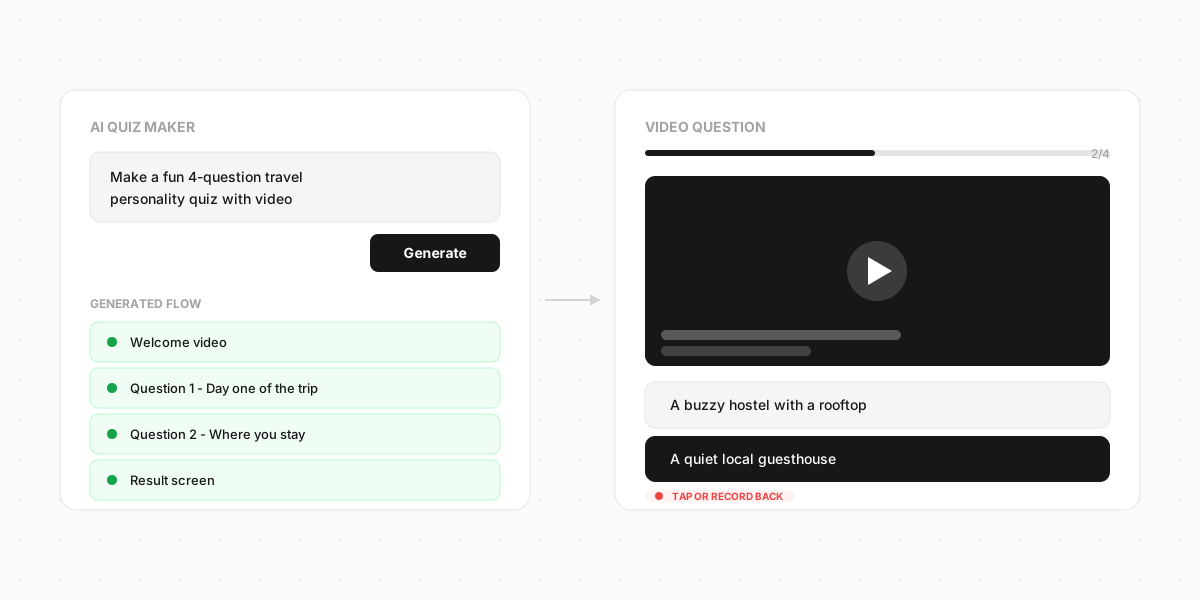
What if instead of typing answers, visitors could record a 30-second video response?
It sounds unusual for real estate, but think about what you learn from a short video that a typed response can never tell you:
- Tone and enthusiasm - are they genuinely excited or politely browsing?
- Specificity - people naturally give more detail when speaking than typing
- Personality - you hear how they communicate, making your follow-up call feel like a second conversation rather than a cold call
- Sincerity - video responses correlate with higher intent. Someone willing to record themselves is almost certainly a serious prospect
A visitor who records a video saying "We loved the backyard but the kitchen layout doesn't work for us - if you see something similar with an open-plan kitchen, call us immediately" is a lead you can act on today. Compare that to a name and email on a clipboard.
With tools like Clipform, you can build an interactive digital sign-in that combines contact collection with video feedback - all accessible via a QR code. Visitors scan, enter their details, and optionally record a quick video about their impression of the property. The response lands in your inbox with an auto-generated transcript, so you can scan it in seconds without watching every video.
Video responses won't work for every visitor or every market. But even if only 20% of your attendees record one, those are almost guaranteed to be your highest-intent leads. The act of recording self-selects for seriousness.
What to do with the data after the open house
Collecting information means nothing without a follow-up system. Here's the sequence that converts:
Within 2 hours
Send a personalised text or email. Reference the specific property they visited. Something like:
"Hi Sarah - thanks for coming through 42 Oak Street today. Would you like me to send you similar 3-bed listings in Maplewood? I have two coming to market next week."
Speed matters enormously here. Every hour you wait to follow up, the visitor is visiting another open house, talking to another agent, or simply forgetting what they liked about your listing. The agents who follow up same-day (ideally within an hour or two) consistently convert more open house visitors into clients.
Within 24 hours
Send a property summary email with photos and key details. Include a question that invites a response: "Did the second bedroom feel big enough for what you need?"
Within 1 week
Add them to a drip sequence of similar listings. Tag them by neighbourhood interest, budget range, and timeline based on what you learned from your qualifying question.
The seller report
Use your sign-in data to create a brief report for the seller: number of visitors, common feedback themes, interest level. This demonstrates your value as a listing agent and often leads to a price or staging conversation based on real visitor feedback rather than guesswork.
If you collected video feedback, sharing (with permission) clips of genuine buyer enthusiasm is one of the most powerful things you can show a seller.
Your sign-in sheet is a lead funnel, not a guest book
The difference between agents who get one deal per open house and agents who get one deal per quarter often comes down to what happens at the door. A thoughtful sign-in sheet - whether paper, digital, or a mix of both - is the entry point to your follow-up system.
Keep the fields short. Give visitors a reason to be honest. Follow up fast. And if you're running open houses every week, consider whether a basic name-and-email sheet is leaving money on the table compared to a modern interactive form that captures real buyer intent.
The open house is the one moment you have face-to-face access to potential clients. Make the sign-in count.