A voice acting demo reel is a short, curated audio sample - usually 60 to 90 seconds total, built from several clips of roughly 15 to 20 seconds each - that shows what you sound like and what you can do across a single genre. It is the single most important tool for getting voice work: agents, casting directors, and studios use it to decide whether to audition you, and most make that call within the first 15 seconds.
The problem with most demo reel advice is that it focuses on recording quality and ignores structure. A professionally recorded demo with the wrong format, wrong length, or wrong material for your target market is still a demo that doesn't get callbacks. This guide covers the types of demo reels you need, what goes in each one, how to record them without spending thousands, and the AI-related changes that are reshaping how demos get submitted and evaluated.
What is a voice acting demo reel?
A demo reel (also called a voice reel or voice-over demo) is a curated audio sample that showcases your vocal range, style, and ability to deliver copy. Think of it as a portfolio compressed into under two minutes.
Unlike an acting headshot, which shows one look, a demo reel needs to show range within a focused category. A commercial demo should show you can sell different products with different energy levels. A narration demo should show you can carry different types of long-form content. Trying to show everything in one reel dilutes all of it.
The industry standard is to have separate demo reels for each genre you work in, rather than one reel that tries to cover everything.
Types of demo reels you need
You don't need all of these on day one, but you should know which ones matter for the work you're pursuing.
| Type | Length | What it shows | Who listens |
|---|---|---|---|
| Commercial | 60-90 seconds | Selling products, brand reads, retail spots | Ad agencies, brands, production houses |
| Narration | 60-120 seconds | Documentary, corporate, explainer, e-learning | Production companies, e-learning studios |
| Character/Animation | 60-90 seconds | Distinct character voices, emotional range | Animation studios, game developers |
| Audiobook | 2-5 minutes | Sustained storytelling, character differentiation | Publishers, audiobook platforms |
| Video game | 60-90 seconds | Character voices under action, combat, emotion | Game studios |
| IVR/Telephony | 30-60 seconds | Clear, professional, instructional tone | Corporate clients, phone system vendors |
Start with one. If you're new, pick the category where you're strongest and build that demo first. A focused commercial demo is worth more than a mediocre reel that tries to cover commercial, narration, and character all at once.
What goes in a demo reel
The structure matters more than most beginners realise. Casting directors don't listen front to back like a song - they skip around, and many stop after 15 to 20 seconds if nothing grabs them.
Commercial demo structure
A commercial reel runs five to six spots, each 10 to 15 seconds long, sequenced so the strongest read lands first. Vary the energy and tone from one spot to the next - that contrast is what proves range in under 90 seconds. Order them like this:
- Your strongest spot first. The one that best represents your natural sound and the work you want to book. Don't save the best for last - nobody gets there.
- A brand with energy. Fast-paced retail, upbeat fitness, enthusiastic tech launch. Show you can bring excitement without losing clarity.
- A conversational read. Warm, relatable, "talking to a friend" style. This is the most in-demand commercial style right now.
- Something serious or sincere. Healthcare, financial services, charity. Prove you have range beyond cheerful.
- A character or personality spot. Something distinctive. A quirky spokesperson, a gruff truck ad, an understated luxury brand.
Each spot should use different copy from a different fictional (or real) brand. Same brand twice signals a thin portfolio.
Narration demo structure
A narration reel is built from four to five segments, each 15 to 30 seconds - slightly longer clips than a commercial reel, because narration is about sustaining a tone rather than nailing a quick hook. Move through distinct content types so a listener hears you handle several formats:
- Documentary or true-crime style. Authoritative, measured, draws the listener in.
- Corporate explainer. Clean, professional, the voice you'd hear over a company's "about us" video.
- Educational or e-learning. Clear, patient, instructional without being condescending.
- Conversational podcast-style. Looser, more personal, as if you're hosting a show.
Narration demos can run slightly longer (up to two minutes) because the form demands it - listeners need to hear whether you can sustain interest over longer passages.
Character/animation demo structure
Five to seven characters, each 8 to 15 seconds:
Show distinct voices that are clearly different from each other. Include at least one that's close to your natural voice (most character work isn't extreme cartoon voices), one high-energy character, and one quieter or more grounded character. Each character should have a clear personality, not just an accent.
How long should your demo reel be?
The ReelCrafter guide to voice-over demos recommends approximately 90 seconds total, broken into segments of 15 to 20 seconds each. That's the upper end. Most casting directors and agents prefer demos closer to 60 seconds for commercial reels.
The exception is audiobook demos, which can run three to five minutes because publishers need to hear sustained performance, character differentiation, and pacing over longer passages.
The 15-second rule: Your best material goes in the first 15 seconds. Many listeners decide in that window whether to keep listening or move to the next submission. If you wouldn't hire yourself based on the first 15 seconds of your demo, restructure it.
Recording your demo reel
You have two options: a professional studio session or a home recording setup. Both can produce demos that get you work - but each comes with tradeoffs.
Professional studio
A guided demo session with a producer/director typically costs $300 to $1,500 depending on the market and the producer's reputation. You get professional direction (someone telling you when a read works and when it doesn't), high-end equipment and treated acoustics, and a polished final product with clean editing and mixing.
When it's worth it: If you're new and don't have trained ears for your own performance yet, a good producer will push you past your comfort zone and help you find reads you wouldn't have discovered on your own.
Home studio
A usable home recording setup runs $200 to $500. You need:
- A condenser microphone. The Audio-Technica AT2020 and Rode NT1 are industry workhorses under $250. USB versions are simpler; XLR versions sound better but need an audio interface.
- An audio interface (if using XLR). The Focusrite Scarlett Solo is the standard entry-level option around $120.
- Acoustic treatment. This matters more than the microphone. A closet full of clothes works in a pinch. Proper foam panels or a portable vocal booth ($50-150) work better. The goal is killing room echo, not soundproofing.
- Recording software. Audacity is free and handles demo recording fine. Reaper is $60 and professional-grade. Logic Pro and Adobe Audition are overkill for demos but work if you already have them.
When it's worth it: If you already have some experience, can self-direct, and plan to record auditions regularly. The home setup pays for itself quickly once you're submitting to casting calls.
Quality check: Record a 30-second test and listen on headphones, laptop speakers, and your phone. If it sounds clean on all three, your setup is good enough. If you hear room echo, hiss, or your voice sounds thin, fix the acoustics before recording your demo.
The AI question: what's changing
AI is reshaping the voice acting industry in ways that directly affect demo reels.
Voice cloning for auditions. Services like ElevenLabs and Replica Studios now let voice actors create digital clones of their voice. Some actors use these to quickly generate audition samples - record once, submit variations to multiple listings. The demo reel hasn't been replaced, but the audition process around it is speeding up.
SAG-AFTRA consent protections. The union has been aggressive about establishing guardrails. Their 2024 Sound Recording Code requires clear consent before any digital replication of an actor's voice, and their 2025 Commercials and Interactive Media contracts extended these protections further. If you're a union member, your demo reel recordings can't be used to train AI models without your written permission.
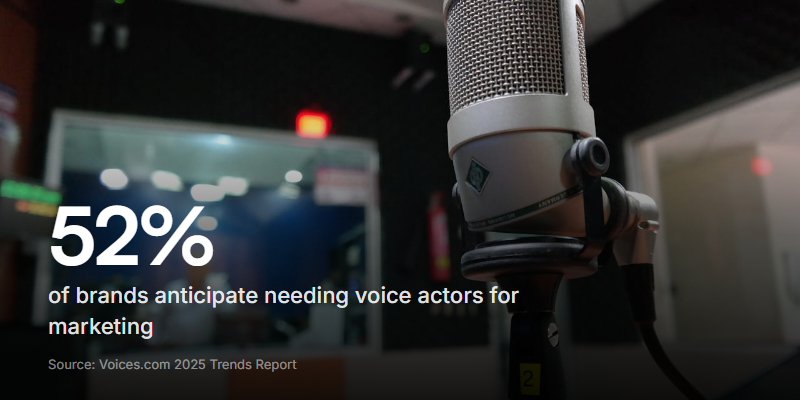
Buyer preferences still favour humans. The Voices.com 2025 Trends Report found that 52% of brands anticipate needing voice actors for marketing, and when buyers do use AI voices, nearly 80% say human-like quality is their top priority. Human demos remain the benchmark that AI is measured against.
What this means for your demo: AI hasn't changed what a good demo reel sounds like. It has changed how demos get distributed and evaluated. Agencies increasingly expect digital submissions (not physical CDs or USB drives), and some use AI-powered tools to pre-screen submissions before a human listens. Making your demo easy to submit digitally isn't optional anymore.
Common mistakes
These are the things that get demos deleted or skipped.
- Too long. A two-minute commercial demo is 30-60 seconds too long. Respect the listener's time. If you can't showcase your range in 60-90 seconds, the issue is editing, not length.
- Starting weak. Your best spot goes first, not last. The 15-second rule exists because casting directors enforce it without telling you.
- Same energy throughout. If every spot sounds like the same person reading different scripts, the demo isn't showing range. Vary your pace, tone, and energy level between segments.
- Using published ads. Recording yourself reading a Nike or Apple script is a red flag. Listeners know what those ads sound like, and your version will be compared unfavourably. Write original copy or use scripts from demo script resources.
- Bad audio quality. Room echo is the biggest amateur signal. Fix your acoustics before upgrading your microphone.
- Outdated material. Demo reels should be refreshed every one to two years. Your voice changes, your skills improve, and the market evolves. A 2022 demo in 2026 tells agents you're not actively working.
- One reel for everything. A single demo that starts with a cartoon voice and ends with a corporate narration confuses the listener. Separate reels for separate categories.
Getting your demo in front of people
A finished demo reel sitting on your hard drive doesn't generate work. How you distribute it matters.
Online platforms. Voices.com, Voice123, Bodalgo, and Casting Call Club are where a significant portion of voice work gets posted and cast. Each platform has its own profile format, and all of them expect uploaded demos.
Agent submissions. Talent agencies accept demo submissions, usually via email or their website's submission form. Most agencies want a specific format: your name, voice type, demo category, and an MP3 or WAV file. Some accept links; others want attachments. Check their submission guidelines before sending anything.
Direct outreach. For commercial work, production companies and ad agencies are worth approaching directly with a short email and a link to your demo. Keep it brief. They'll listen if they need your type; they won't read a long pitch email regardless.
Your own website. A simple page with your demos, a short bio, and a contact form. This is where agents and clients end up when they Google you after hearing your name - make sure something exists there.
Making submissions easier
The friction in demo reel submissions is real. Agents get hundreds of emails with MP3 attachments. Production studios get submissions in a dozen different formats. Everything ends up in inboxes where it's hard to compare, organise, or even find again. It is the same bottleneck on-camera actors hit with self-tape auditions: different medium, identical inbox chaos.
If you're on the receiving end - an agency collecting demo submissions, a studio accepting auditions, or a production company building a talent roster - the fix is a structured submission form that collects everything in one place: name, voice type, demo category, and the audio recording itself.
Clipform lets you build exactly this. You can set up a submission form where voice actors select their category, record a demo clip directly in the browser or upload an existing file, and submit everything in a single flow. Every submission lands in a dashboard where you can play demos side by side, read auto-generated transcripts, and filter by voice type. It's a cleaner process than sifting through email attachments.