A brand ambassador application is a form that collects structured information from people who want to represent your brand. Instead of managing DMs, emails, and spreadsheets, a dedicated form puts every applicant's details in the same format, in the same place, ready to compare.
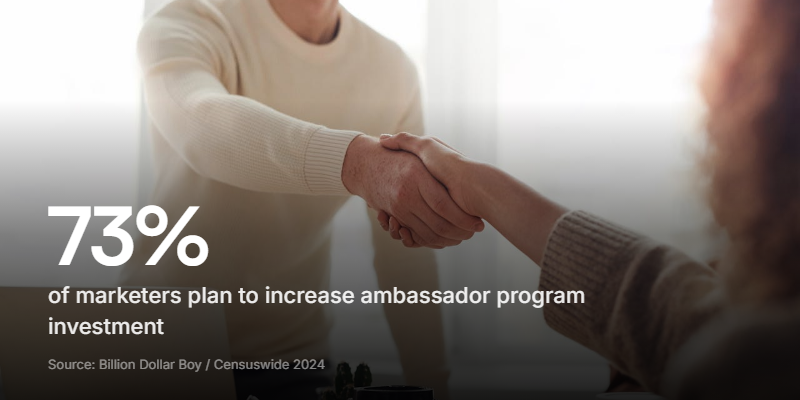
Ambassador programs are growing fast. Research from Billion Dollar Boy and Censuswide found that 73% of marketers plan to increase their investment in brand ambassador programs over the next 12 months. But most brands are still collecting applications through generic contact forms, Google Forms, or an email address buried in their website footer. The result is a messy inbox, inconsistent submissions, and no real way to compare applicants side by side.
This guide covers what belongs in a brand ambassador application form, how tiered programs work, why video introductions are the best predictor of ambassador quality, and how to set the whole thing up without building anything custom.
Brand ambassadors vs. content creators
Before building your application, it helps to know what you're recruiting for. Brand ambassadors and content creators overlap, but the commitment and relationship are different.
| Brand ambassador | Content creator | |
|---|---|---|
| Relationship | Long-term, ongoing | Campaign-based, project-by-project |
| What they do | Represent the brand in daily life, share discount codes, attend events, post regularly | Produce specific content deliverables (videos, photos, reviews) |
| Compensation | Commission, free product, discount codes, tiered perks | Per-post fees, flat campaign rates |
| Who they are | Loyal customers, fans, micro-influencers | Professional or semi-professional creators |
| Volume | Many (often dozens to hundreds) | Fewer, more selective |
An ambassador program usually casts a wider net. You're looking for people who genuinely use and like your product, not necessarily people with large followings. That changes what you ask on the application form and how you evaluate responses.
If you're looking for campaign-based creators instead, see our guide on content creator applications.
What to include in a brand ambassador application
The form needs to collect enough to evaluate fit without being so long that nobody finishes it. Five to seven sections, three to five minutes to complete. Here's what matters.
Contact details
Name, email, and optionally phone number and location. Location matters if you run regional campaigns, need to ship product, or host in-person events.
Social media profiles
Links (not just handles) to their active platforms. Give separate fields for Instagram, TikTok, YouTube, and Twitter/X rather than a single "social media" text box. Separate fields make it easier to verify accounts and compare applicants by platform.
Ask for their primary platform and approximate follower count. You don't need exact analytics at the application stage. A rough number is enough to sort micro-influencers from larger accounts.
How they know your brand
This is the most important text field on the form. "How did you discover [Brand], and what's your experience with our products?" tells you whether someone is a genuine fan or just applying to every program they can find.
Look for specifics. "I've been using your running shoes for two years and I ran my first half marathon in them" is a different applicant from "I love your brand and think I'd be a great fit." The first person is already an ambassador. The second is filling out a form.
Content style and niche
What kind of content do they create? Multiple-choice works well here: fitness, beauty, fashion, food, tech, lifestyle, parenting, outdoor, wellness. Let them pick two or three.
This helps you match applicants to the right campaigns and avoid sending skincare products to someone who only posts about mountain biking.
Why they want to be an ambassador
Short open-ended question, 200 to 500 characters. "Why do you want to join the [Brand] ambassador program?" This filters for people who understand what an ambassador does (ongoing representation, not a one-off sponsorship).

Video introduction
A 30 to 60-second video where they introduce themselves and show why they'd be a good ambassador. This is the single most valuable field on the form, and most application forms skip it entirely. More on why this matters below.
Availability and terms
Quick-filter questions to catch mismatches early:
- How many posts per month can you commit to?
- Are you currently representing any competing brands?
- Are you available for in-person events?
- What's your preferred compensation (product, commission, flat rate)?
These save everyone time. If someone wants a flat fee per post and your program is commission-based, you both know upfront.
Tiered ambassador programs
Most successful ambassador programs use tiers. Instead of treating every ambassador the same, you create levels with different requirements and perks. New ambassadors start at the bottom and move up based on performance.
Why tiers work
- Lower barrier to entry. Your first tier can be open to anyone with a genuine connection to the brand, regardless of follower count. This brings in real fans, not just influencers shopping for deals.
- Built-in motivation. Ambassadors who can see a path to better perks (higher commission, exclusive products, event invitations) stay engaged longer.
- Easier to manage. You can focus your time on top-tier ambassadors while giving lower tiers a mostly automated experience.
A typical tier structure
| Tier | Requirements | Perks |
|---|---|---|
| Community | Apply and be accepted. No minimum followers | Discount code (10-15%), early access to new products, brand swag |
| Rising | 3+ posts/month, 500+ followers, 3 months active | Higher commission (15-20%), free product for review, featured on brand social |
| Elite | Consistent posting, strong engagement, 6+ months active | Highest commission (20-30%), exclusive events, co-creation opportunities, dedicated brand contact |
The exact tiers depend on your brand and program size. The point is that the application form is the entry point to Tier 1, not a final selection. You're filtering for genuine interest and basic fit, not demanding a media kit from every applicant.
Your application form should match your first tier. If Tier 1 is open to anyone who loves the brand, don't ask for engagement rates and media kits on the application. Save those questions for tier-up evaluations. A five-question form with a video intro will get you more (and better) applicants than a fifteen-field application that feels like a job interview.
Why video introductions matter
Most brand ambassador applications collect text, links, and maybe a file upload. Almost none ask applicants to record a video. That's a missed opportunity.
A 30 to 60-second video introduction tells you more about someone's potential as an ambassador than every other field on the form combined. You see their personality, energy, how naturally they talk about your brand, whether they come across as authentic or rehearsed. These are the exact qualities that determine whether their posts will feel like genuine recommendations or forced advertisements.
What to ask for: "Record a short video (30-60 seconds) introducing yourself and telling us why you'd be a great ambassador for [Brand]." One prompt, one recording.
The people who record a natural, enthusiastic video are almost always the ones who produce great ambassador content. The people who can't get through 30 seconds on camera are telling you something important about how they'll represent your brand online.
The friction problem: Most form builders don't support in-browser video recording. If you add a "video" field, it's usually a file upload, which means the applicant has to record separately, find the file, check the format, compress it, and then upload. Most won't bother. You lose good applicants to a bad process.
The fix is a form that lets them record directly in the browser. Open the camera, speak, submit. No file management, no separate uploads, no format headaches.
How to evaluate ambassador applications
Once applications start coming in, you need a system. Without one, you'll either approve everyone (diluting your program) or take so long to respond that good applicants move on.
First pass: filter quickly
Spend 10 to 15 seconds per application. Filter out:
- No social media presence (dead links, no recent posts)
- Content that clearly doesn't fit your brand
- Location mismatch for regional programs
- Generic "why" answer with no specifics about your brand or product
Second pass: watch the videos
This is where video introductions pay off. For the remaining applicants, watch their video intros. You're looking for:
- Authenticity. Do they sound like a real person who uses your product, or like someone reading a script?
- Energy. Are they genuinely excited, or just going through the motions?
- Camera presence. Would you want this person representing your brand in a story or reel?
- Brand knowledge. Do they mention specific products, experiences, or reasons they connect with your brand?
A 30-second video gives you more signal than a page of text answers. You can evaluate dozens of video intros in the time it would take to deeply review a handful of written portfolios.
Third pass: verify and respond
For your shortlist, check their social profiles. Look at recent posts, engagement patterns, and whether their audience matches your target customer. Then respond quickly. Good ambassadors are being recruited by multiple brands, and the one that replies first usually wins.
Common mistakes with ambassador applications
Making the form too long. If your application takes more than five minutes, you'll lose applicants. Ambassador programs are supposed to attract real fans, not professional application-fillers. Keep it short.
Treating it like a job application. Asking for a resume, cover letter, or detailed media kit on the initial application scares off the casual fans who would make your best ambassadors. Save the detailed evaluation for later.
No video field. You're recruiting people to represent your brand visually on social media. Not seeing them on camera before accepting them is like hiring a salesperson without a conversation.
Follower count as the primary filter. An applicant with 800 followers who has been buying your products for three years is worth more than someone with 50,000 followers who has never used your product. Filter for brand affinity and engagement, not vanity metrics.
Slow follow-up. If someone applies and hears nothing for three weeks, they've already forgotten about your program. Set a response window and stick to it. Even "we'll review your application within 5 business days" is better than silence.
No confirmation or next steps. After someone submits, tell them what happens next. When will they hear back? What does the process look like? A blank screen after submission makes your program look unorganised.
Using a generic contact form. A "contact us" page with a message field is not an ambassador application. It collects the wrong information, creates no reviewable pipeline, and signals that your program isn't a priority.
Set up your ambassador application form
If you're building an ambassador application from scratch:
- Pick your form tool. You need text fields, multiple choice, links, and ideally video recording. If video isn't built in, you'll need a separate step for video review, which most applicants won't complete.
- Keep the form short. Contact details, social links, brand connection, a "why" question, and a video intro. Five sections, under five minutes.
- Set up notifications. Know when applications come in so you can respond quickly.
- Share the link everywhere. Your website, your Instagram bio, your email signature, your packaging inserts. One link, one form, every applicant in the same pipeline.
Clipform handles all of this in one form. Ambassadors record a video introduction directly in the browser - no uploads, no file size limits, no format issues. The rest of the application (contact details, social links, brand connection) lives in the same flow. Every submission lands in a dashboard with auto-transcribed video, structured data, and filtering. If you're running an ambassador program and want to see applicants on camera before you let them represent your brand, it's built for exactly this.