
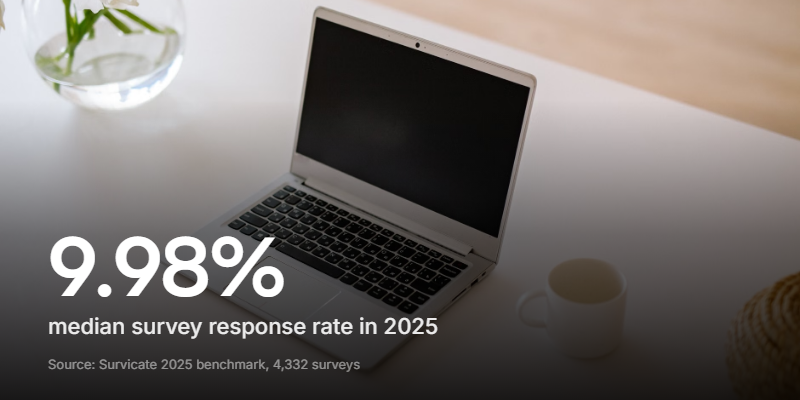
You sent the survey. Barely anyone replied. It's not you: the median survey gets a response rate of just 9.98%, according to Survicate's 2025 benchmark of 4,332 surveys across 460 companies. For every ten people you ask, about one starts.
The good news is that response rate is mostly in your control. The biggest wins aren't clever question wording. They're the channel you send on, how long the survey is, and whether people can answer the way they'd rather answer.
Here are nine fixes, ordered by how much they move the needle. Start at the top.
What's a good survey response rate?
For most external surveys, 20-30% is a respectable band and anything above 30% is top-quartile. But the middle of the pack is much lower: Survicate's 2025 data puts the median at 9.98%, with the middle 50% of surveys landing between 3.75% and 21.69%.
So if you're sitting around 10%, you're normal. Normal just isn't the goal. The gap between a 10% survey and a 30% survey is rarely the questions. It's everything around them.
Two things matter before you start: what "response rate" even means for you, and why the number keeps slipping.
Why survey response rates keep falling
People are more over-surveyed than ever, and AI made it worse from both sides.
It's never been easier to spin up a 40-question survey and blast it to a list, so inboxes are fuller. At the same time, bots and AI now fill surveys in to farm incentives, so teams add more screening questions and follow-ups, which tires out the real respondents even faster. We dig into this in the survey fatigue guide.
The takeaway: you can't out-write fatigue. You have to ask less and make the ask feel lighter. That's what the next nine fixes do.
1. Fix the channel before you touch the copy
Where you ask changes the response rate more than what you ask. An email link and an in-the-moment prompt are not the same game.
Email links are self-selecting and easy to ignore. Asking someone right when they're already in your product, or right after a purchase, catches them while the experience is fresh and they're already paying attention. Before you rewrite a single question, ask whether email is even the right channel for this survey.
2. Cut it to five questions
Length is the single biggest thing you control. Every extra question is another reason to quit.
Be ruthless. For each question, ask what you'd actually do differently based on the answer. If there's no decision attached, cut it. Most feedback surveys can get what they need in five questions or fewer, and shorter surveys finish at far higher rates than long ones.
The test for every question: "What will I do differently depending on the answer?" If you can't name a decision, the question is costing you responses without earning its keep. Cut it.
3. Show one question at a time
A wall of fields signals "this will take a while". One question per screen feels light, even when the survey isn't short.
It works. Typeform's 2024 Data report found this conversational, one-question-at-a-time format averaged a 47.3% completion rate, against a 21.5% industry average. That's more than double, from layout alone. More on the format in our conversational form guide.

4. Let people talk instead of type
A lot of drop-off is typing fatigue. Open-text boxes come back with "fine" and "good" because typing a real answer on a phone is a chore.
Let people record a quick voice or video reply instead. It's faster for them, and you get richer answers than a rushed sentence. The same Typeform report found forms with images or video saw a 120.6% jump in completions over plain ones. Visual, spoken formats keep people moving.

5. Time the ask to the moment
A survey that lands mid-task gets closed. One that lands weeks after the thing it's about gets ignored because nobody remembers.
Send it close to the moment it's asking about, while the memory is sharp, and when the person actually has a spare minute. A post-purchase survey works best right after the purchase, not a fortnight later. Our customer feedback form guide covers picking the moments that matter.
6. Personalize the invite and send one reminder
A generic "We value your feedback" blast reads like spam. Using the person's name and referencing the specific thing they did lifts opens and starts.
Then send exactly one reminder to people who didn't respond. One well-timed nudge recovers a meaningful chunk of responses. Two or three tips over into nagging and drives unsubscribes, which costs you future responses.
7. Be transparent, then close the loop
Tell people up front how long it'll take and what you'll do with their answers. "Three questions, two minutes, it shapes next quarter's roadmap" beats a vague ask every time.
Then actually close the loop: tell them what the last round of feedback changed. Nothing earns the next response like proof the last one mattered. Most people don't believe their feedback does anything, so showing that it did is a genuine edge.
When video beats text (and when it doesn't)
Switching to a spoken, one-at-a-time format isn't always right. Be honest about the fit.
It shines when you want depth: open feedback, testimonials, user research, exit interviews. Hearing someone explain why in their own words beats a star rating you have to interpret. People also give more when a form feels like a conversation than when it feels like a spreadsheet.
It's overkill for a single NPS score, and it can feel exposing for sensitive or anonymous topics, so always offer a text option too.
Rule of thumb: if you just want a number, ask one quick text question. If you want to understand the why behind it, let people talk. The richer the answer you need, the more the format earns its place.
Where Clipform fits
Most of these fixes come down to format and channel, and that's what Clipform is built for. Surveys run one question at a time, and respondents can answer by text, voice, or video recorded straight in the browser, so people who'd never type a paragraph will happily talk for thirty seconds.
Every voice and video answer is transcribed automatically, so you're reading replies, not rewatching clips. You can describe the survey you want and have it generated for you, then embed it in your product or share a link. It won't fix a survey you send too often, but it makes the ones you send much easier to finish.
Start getting more responses
A 10% response rate isn't a wording problem. People are asked too often, on the wrong channel, in a format that feels like work. Fix those and the number climbs.
Start with the top three: check the channel, cut the survey to five questions, and show one question at a time. Then let people talk instead of type, and tell them what their answers changed. Each one compounds.
If you want a survey that feels like a conversation rather than a chore, give Clipform a try - your first one is free to build.
Common questions about survey response rates
What is a good survey response rate? For most external surveys, 20-30% is respectable and above 30% is top-quartile. The 2025 median across a large benchmark was under 10%, so anything in the twenties is doing well.
How do I increase my survey response rate? Start with channel and length: ask in the moment instead of by email blast, cut to five questions, and show one at a time. Then let people answer by voice or video, time the ask well, personalize the invite, send one reminder, and share what changed.
Why is my survey response rate so low? Usually because it's too long, sent on the wrong channel, badly timed, or people have been surveyed too many times already. A 10% rate is close to the median, not a failure, but it leaves a lot of answers on the table.
Do incentives improve survey response rates? They can lift starts, especially for longer or research surveys. But an incentive won't rescue a survey that's too long or badly timed, and it can attract low-quality or bot responses, so fix the format first.