A video sales letter (VSL) is a short video built to do one job: get the viewer to take a single action by the time it ends. Buy the product. Book the call. Start the trial. It replaces a long written sales page with someone talking straight to camera, walking you from your problem to their offer.
That's the whole idea. A written sales page asks you to read. A VSL asks you to watch and listen, and most people would rather do that. The name is a throwback to the direct-response sales letters of print and mail, just rebuilt for a screen.
You've almost certainly sat through one. The course that made you watch a 20-minute video before it showed the price. The coaching page with a play button and nothing else above the fold. The software demo that told a story before it asked for your email. All video sales letters, all doing the same move: sell one thing, to one person, in one sitting.
This guide covers what a VSL is, the structure nearly all of them follow, how long yours should be, and the shift that's quietly reshaping the format in 2026. Because the classic VSL has a weakness, and the fix is more interesting than another script template.
What a video sales letter actually does
A VSL has one conversion goal and refuses to get distracted from it. That single-mindedness is the point. Every second either moves the viewer closer to the action or it gets cut.
You'll find them wherever one clear offer needs selling:
- Course creators and coaches use a VSL as the whole pitch page for a program.
- SaaS and software use one to turn a cold visitor into a trial signup.
- Direct-to-consumer brands run short VSLs as paid ads that lead to a product page.
- Agencies and consultants use one to book discovery calls without repeating the same spiel on every call.
The common thread is a decision the viewer can make right now. A VSL is built for one offer and one yes. General awareness or explaining your whole company is a different tool's job.
Why a video outsells a wall of text
People are wired to respond to a face and a voice. You read tone, pacing, and expression in a video the way you never can from a paragraph, and that reads as trust. It's the same reason a shop assistant closes more sales than a spec sheet.
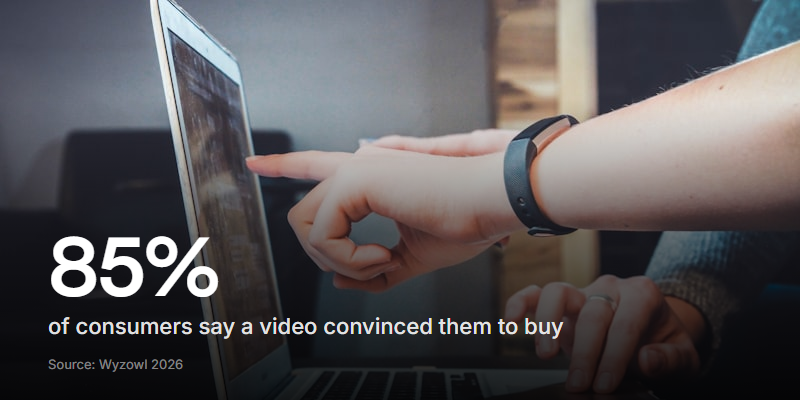
The numbers back it up. In Wyzowl's 2026 Video Marketing report, 85% of people said watching a video has convinced them to buy a product or service. Video is now the format most likely to move a purchase decision, and 91% of businesses use it as a marketing tool.
A VSL leans on all of that. It carries the emotion of a real person, the clarity of a structured pitch, and the pacing you control frame by frame. A text page hands the reader the remote and hopes they don't skim to the price. A video keeps them on your rails until the offer lands.
The anatomy of a video sales letter
Almost every VSL follows the same persuasion arc, because it works. Think of it as six beats that build on each other, ending on the one action you want.
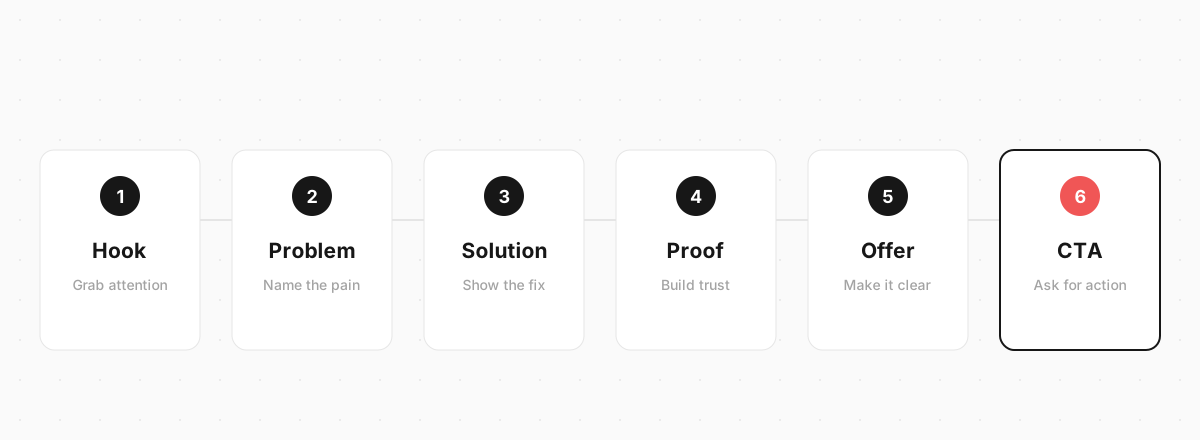
| Beat | What it does | Keep it to |
|---|---|---|
| Hook | Grabs attention in the first few seconds with a bold claim, a sharp question, or the exact pain the viewer feels | 5-15 seconds |
| Problem | Names that pain clearly, so the viewer thinks "yes, that's me" | 30-60 seconds |
| Solution | Introduces your product as the way out, and explains the mechanism behind it | 1-3 minutes |
| Proof | Backs the claim with testimonials, results, demos, or credentials | 1-2 minutes |
| Offer | Spells out exactly what they get, for how much, with any bonus or guarantee | 1-2 minutes |
| CTA | Asks for one specific action, plainly, with no competing links | 15-30 seconds |
The hook does the heavy lifting. If the first ten seconds don't land, the other five beats never get watched. Write it last, once you know the strongest thing you can say, and make it the sharpest line in the whole script.
One rule holds the structure together: a VSL drives to a single CTA. No "and also follow us." No three buttons. One action, repeated at the end, so the viewer never wonders what to do next. For the different shapes this arc takes in the wild, our video sales letter examples break down seven that convert.
How long should a video sales letter be?
There's no perfect length, only the right length for the offer and the audience. VSLs split into two camps.
- Short-form (60 seconds to 5 minutes). Best for lower-priced products, paid ad traffic, and warm audiences who already know you. It respects a short attention span and gets to the point fast.
- Long-form (10 to 45 minutes). Used for high-ticket offers, courses, and cold traffic that needs the full story before spending real money. The length itself does work here, filtering out anyone who isn't serious.
The honest tradeoff: long VSLs can convert extremely well for the right offer, but they're a big ask. Every extra minute is another chance for the viewer to close the tab. If you're unsure, start shorter. You can always test a longer cut against it and let the numbers decide.
VSL vs explainer, demo, and testimonial videos
A VSL gets confused with other sales videos, but the job is different. The difference comes down to the goal.
| Video type | Main goal | Ends with |
|---|---|---|
| Video sales letter | Make one sale or booking | A single, direct CTA |
| Explainer video | Help someone understand what you do | Light or no CTA |
| Product demo | Show the product working | "See the full features" |
| Testimonial video | Build trust through a customer's words | Social proof, no ask |
You can borrow pieces from all of them. A VSL often folds in a short demo and a testimonial clip as its proof beat. But only the VSL is built end to end to close.
What AI changed about VSLs in 2026
Here's the part most older guides miss. In the last couple of years, AI turned VSL production upside down.
Script-to-video tools like Synthesia and HeyGen now let you paste a script, pick an avatar, and get a finished video with voiceover and captions in minutes. No camera, no studio, no on-camera nerves. For anyone who hated filming themselves, that's a real unlock.
But it cuts both ways. When anyone can spin up a polished avatar VSL in an afternoon, the format gets crowded, and viewers get sharper at spotting the synthetic ones. The thing that made VSLs convert in the first place was a real person earning your trust. A generic AI avatar reading a template can undercut that.
If you use AI to produce a VSL, keep a real human somewhere the viewer can feel it. Your own voice over AI visuals, a genuine testimonial clip, or a face they can actually reply to. The trust has to come from somewhere real.
So AI made VSLs cheaper and faster to make. It also made the average one less special. The teams pulling ahead aren't the ones making more VSLs. They're the ones making the format do something a recording never could.
The interactive video sales letter
Every classic VSL shares one flaw: it only talks. The viewer sits and watches, and if they have a question, an objection, or a "wait, does it do X?", there's nowhere for that to go. They just leave. You never even know they were close.
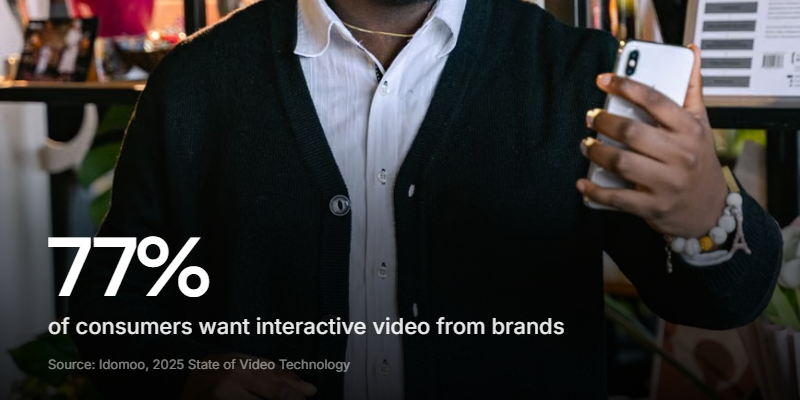
That's a big miss, because passive watching is what audiences have started to move past. In Idomoo's 2025 State of Video Technology report (a survey of 2,510 adults across the US and UK), 77% of consumers said they want interactive video from brands, rising to 93% among Gen Z. Only 30% said they'd ever actually received one.
The supply gap is just as wide. Wyzowl's 2026 report found interactive video is one of the least-used formats going, made by only 31% of businesses. So the audience is asking for two-way video, and almost nobody is handing it to them.
An interactive video sales letter closes that gap. It keeps the persuasion arc of a normal VSL, then adds the one thing a recording can't do: it lets the viewer respond. Watch the pitch, then answer a question, pick the option that fits, or record a quick reply about what's holding them back. The interactive video format turns a monologue into an actual exchange.
In practice, that looks like a short video form. You record your pitch as the prompt (or type it and let AI voice it), and the viewer answers in the browser with no app or account. From there you can:
- Route them by their answer. With conditional branching, a "ready to buy" and a "just looking" can lead to different follow-ups, so each person only sees what's relevant to them.
- Capture the lead in the same flow. A lead capture step grabs a name and email right after the pitch, while intent is highest.
- Hear the real objection. Let them record a reply, and you learn why people hesitate, in their own words. That's the same reason video testimonials beat written ones for proof.
A recorded reply also holds up better in the AI era. A typed answer is trivial to auto-generate now. A genuine video reply, with a real face and voice, is far harder to fake, which makes it a stronger buying signal exactly when text is getting noisier.
You still open with a hook and close with a CTA. You just stop losing the people who had one more question.
How to make a video sales letter that converts
Whichever version you build, the same steps get you there.
- Pick one action. Decide the single thing this VSL exists to make happen before you write a word. Everything serves that.
- Script the six beats. Hook, problem, solution, proof, offer, CTA. Write the hook last and make it your best line.
- Record it (or generate it). Film yourself for maximum trust, or use an AI tool for speed. Keep your energy up and your pacing tight.
- Add a way to respond. Give the viewer a next step inside the video itself, not just a button below it. A question, a choice, or a reply keeps the warm ones from slipping away.
- Share it and watch the drop-off. Put it where your traffic already is, then see where people stop watching. That's your next edit.
FAQ
What is a video sales letter in simple terms?
It's a video built to sell one thing. Instead of a long written sales page, someone talks to camera and walks the viewer from their problem to a single offer, ending with one clear call to action like "buy now" or "book a call."
How long should a VSL be?
It depends on the offer. Short VSLs run 60 seconds to 5 minutes and suit cheaper products, ads, and warm audiences. Long-form VSLs run 10 to 45 minutes and suit high-ticket offers and cold traffic that needs the full story. If you're unsure, start short and test a longer cut against it.
Are video sales letters still effective in 2026?
Yes, but the bar has risen. AI tools made one-way VSLs cheap and common, so the format is crowded. The ones that still convert either feel genuinely human or let the viewer respond, rather than just play a polished monologue at them.
What's the difference between a VSL and an explainer video?
Goal. A VSL is built end to end to make one sale or booking and ends with a direct CTA. An explainer video helps someone understand what you do and usually has a soft CTA or none. A VSL often includes a short explainer as part of its pitch.
Do I need to be on camera to make a VSL?
No. You can film yourself for maximum trust, or use an AI script-to-video tool to generate a presenter and voiceover. A middle path is your own voice over simple visuals, which keeps a real human in the mix without needing to be on screen.
Where the video sales letter goes next
A video sales letter is still the most direct way to sell one thing to one person on a screen. The structure that's worked for decades, hook through to a single CTA, hasn't changed, and it isn't going to.
What's changing is the direction of the video. AI made the one-way VSL cheap enough that everyone has one, which is exactly why the ones that let the viewer talk back are starting to stand out. The audience has been asking for it. Most brands still haven't caught up.
If you're building your first VSL, start with the six beats and one clear ask. When you're ready to make it two-way, Clipform lets you put your pitch and the viewer's reply in the same short flow. Our guide to interactive video is a good next read for where the format is heading.