A video sales letter (VSL) is a sales pitch delivered as a video. One video, one goal: get the viewer to take the next step, whether that's buy now, book a call, or start a trial. It's the same job an old long-form sales page did, only with a face, a voice, and a play button instead of ten screens of text.
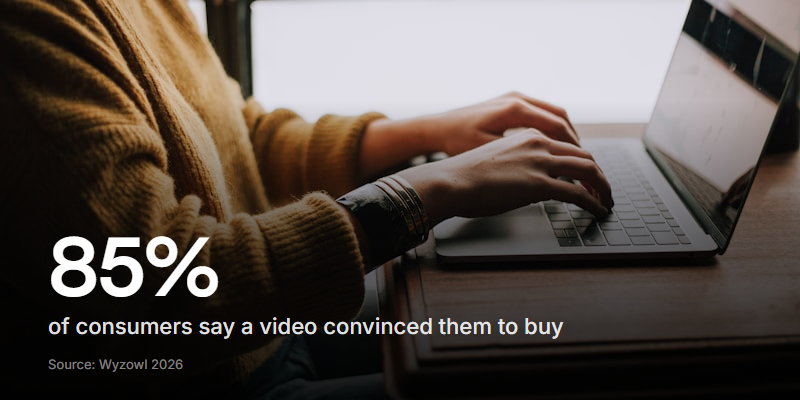
The format works because video sells. According to Wyzowl's 2026 report, 85% of people say a video has convinced them to buy a product or service. A good VSL puts that persuasion right where the buying decision happens.
But most video sales letter examples you'll find are the same thing: one person talking at the camera for three minutes while you sit and watch. Some convert brilliantly. Below are seven examples that do, sorted by the job each one is best at - and then a newer kind of VSL that lets the viewer take part instead of just watching. Almost nobody is making that one yet.
1. The founder talking to camera
The simplest VSL there is: you, on camera, explaining what you sell and why it's worth it. No studio, no teleprompter, just a person who clearly knows the product.
It works because it's the most human option on the list. People buy from people, and a founder who can explain the problem in plain words builds trust faster than any polished animation. It's also the cheapest to make. A decent webcam and good light will do.
Best when: you're early, the product is basically you, or trust is the main thing standing between a visitor and a purchase.
2. The screen-share demo
For software, the strongest VSL is often just showing the thing working. You narrate while your screen does the talking: here's the problem, here are the three clicks that fix it, here's the result.
Seeing beats being told. A demo VSL answers the "but how does it actually work" question that talking heads leave open, and it quietly pre-qualifies buyers who watch to the end. Blend a few seconds of your face at the start and finish so it doesn't feel like a faceless tutorial.
Best when: you sell software, a workflow, or anything where "show me" beats "tell me."
The webcam-plus-screen combo is the SaaS default for a reason. A few seconds of your face at the top and tail turns a screen recording into a person showing you around, instead of a help doc nobody asked for.
3. The problem-agitate-solve pitch
This is the copywriter's VSL, and it's the backbone of most high-converting ones. You open on the viewer's problem, press on why it hurts, then present your product as the way out. The structure has a name in direct-response circles - PAS, or problem, agitate, solve - and marketers like Jon Benson made the format famous.
It earns attention before it asks for anything. By the time the offer lands, the viewer already agrees they have a problem worth solving. That's why a scrappy PAS video often out-converts a beautiful one that skips straight to the pitch.
Best when: your audience feels the pain but hasn't connected it to a solution yet.
4. The testimonial-led VSL
Instead of you making the case, your customers make it for you. A testimonial-led VSL strings together short clips of real people saying what changed for them, topped and tailed with your framing and a CTA.
Social proof is the lever. A prospect quietly discounts what you say about yourself and trusts what a peer says about you. Real video testimonials are hard to fake, which is exactly why they land - a face and a voice carry weight a written quote never will.
The catch is collecting them. Getting customers to record a clip is the whole battle, and most teams never even ask.
Best when: you have happy customers and a product where trust is the blocker.
A prospect will believe ten seconds of a real customer over ten minutes of you. That's the whole reason a testimonial-led VSL works.
5. The explainer or animated VSL
Some products are hard to point a camera at. An API, a concept, a service that lives in the abstract. An animated explainer VSL turns the invisible into something you can see: simple motion, clear narration, one idea at a time.
It works when a live demo would confuse more than clarify. The tradeoff is cost and time. Good animation isn't cheap, and a bad one looks like every other stock-motion video. Only worth it when the clarity payoff is real.
Best when: the product is abstract and a plain demo wouldn't land.
6. The short-form social VSL
The VSL escaped the landing page. A 30-to-60-second vertical pitch on TikTok, Reels, or Shorts is a VSL built for the feed: hook in the first second, problem, product, then the CTA in the caption or a link.
It works because the attention is already there, and short beats long when the viewer never chose to watch in the first place. The discipline it forces - one idea, no filler - often makes the pitch sharper than the three-minute version ever was.
Best when: you're selling to a scrolling audience, not a landing-page visitor.
7. The interactive VSL (the one almost nobody makes)
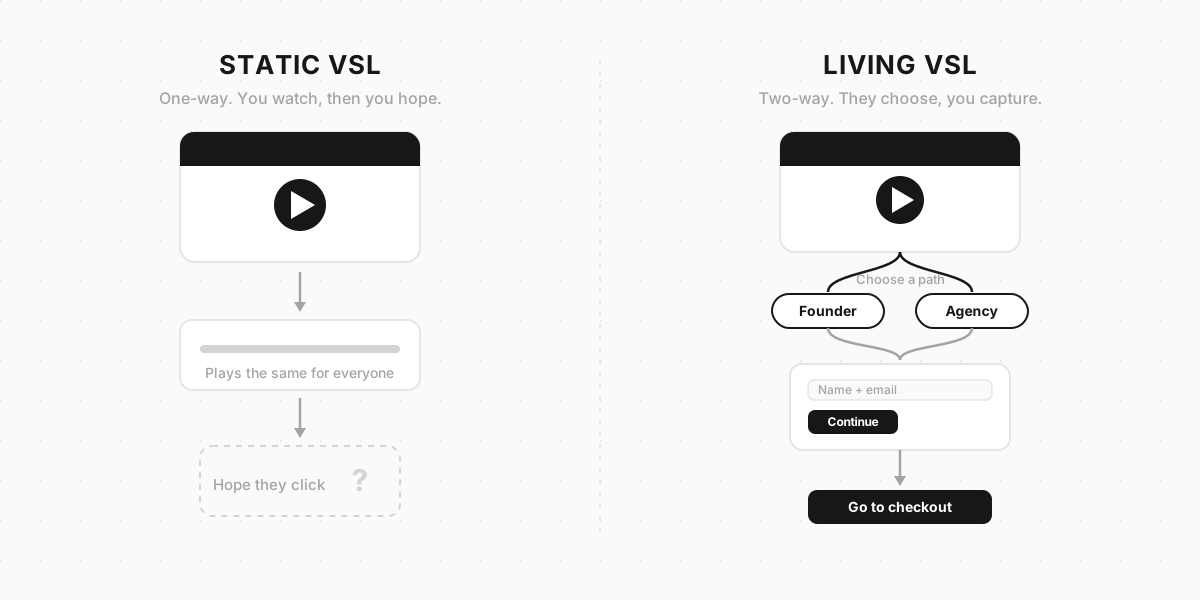
Every example so far is one-way. The viewer watches; you hope they act. The interactive VSL flips that. The viewer watches, then does something - picks which pitch they see next, answers a question, or records a reply - and hands over their details in the same flow.
Think of it as a VSL you can live inside instead of just sit through. You open with a short video, ask "what are you here to fix?", and branch: the founder sees one path, the agency sees another. By the end you haven't only pitched. You've qualified the lead and captured them, with no separate form to bolt on.
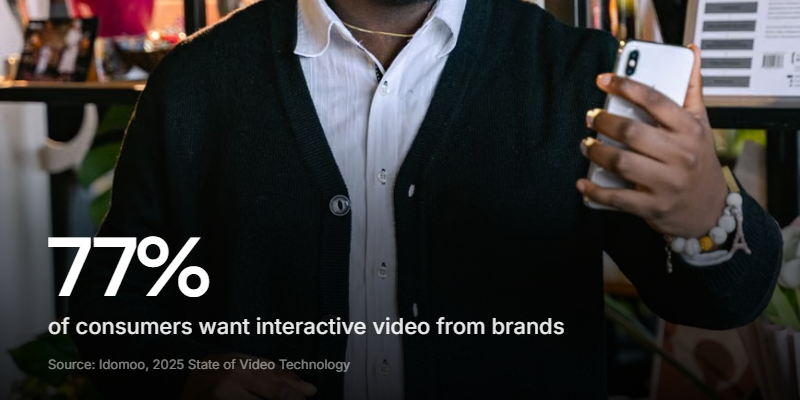
This is the wide-open lane. According to Idomoo's 2025 report (2,510 US and UK adults), 77% of shoppers want interactive video from brands, but only 30% have ever received one. Nearly every VSL online is still a monologue, so the interactive version stands out by simply existing. It's the marketing cousin of the wider interactive video shift, and a close relative of the quiz funnel.
What every VSL example has in common
Strip the styles away and the VSLs that convert share the same skeleton. The format changes; the bones don't.
- A hook in the first 5 to 10 seconds. A bold question, a surprising fact, or the exact problem the viewer feels. Lose them here and the rest never plays.
- The problem, named out loud. People lean in when you describe their situation better than they could.
- The solution, shown not just claimed. A demo, a before-and-after, a walk-through. Proof beats adjectives.
- Evidence. A result, a number, a customer clip. One real proof point does more than five promises.
- One call to action. The single fastest way to kill a VSL is to offer two next steps.
Pick one next step and point the whole video at it. A VSL that asks for a purchase and a newsletter signup and a follow usually gets none of them.
How to make an interactive VSL
The classic examples above are well covered elsewhere. The interactive one isn't, so here's the practical version. This is the kind of flow Clipform is built for, and every piece below is a live feature, not a someday promise.
1. Record the pitch as short prompts
Break the sales letter into a few short video steps instead of one long take. Keep each under 30 seconds so it feels like a conversation, not a lecture. Don't want to film? Type the script and let AI voiceover narrate it for you.
2. Let the viewer choose a path
Add a choice near the start - "what brings you here?" - and branch each answer to a pitch made for that person. A founder and an agency don't need the same three minutes, and a viewer who picks their own path is already leaning in.
3. Capture the lead inside the video
Drop in a details step to collect a name and email (with a consent checkbox) right where interest peaks, not on a separate page afterwards. The same "earn the ask, then ask" rule that makes a good lead capture form work applies here: let them get invested first.
4. Send them to the next step
End on a clear action. Point the final screen straight at your checkout or booking page, or hand over a link on a custom end screen. One video has now pitched, qualified, captured, and routed - the whole job a landing page and a form used to split between them.
5. See where they drop off
Because it's a form under the hood, you get views, starts, and completions, so you can spot the step where people bail and fix it. A static VSL on YouTube can't tell you that.
You don't need a big production to try this. Take a VSL script you already have, cut it into three or four short prompts, add one branching question and an email step, and you've turned a monologue into something the viewer takes part in. If you're gating a lead magnet the same way, the lead magnet funnel does capture and delivery in one flow.
FAQ
What is a video sales letter?
A video sales letter (VSL) is a sales pitch delivered as a single video with one goal: get the viewer to take a specific action, like buy, book a call, or start a trial. It's the video version of a long-form sales page, and it usually runs on a landing page, in an email, or as a paid ad.
How long should a video sales letter be?
Long enough to make the case, short enough to hold attention. Cold traffic on social often converts best at 30 to 90 seconds. A warm audience on a landing page will sit through 2 to 5 minutes if the hook lands. Match the length to how much the viewer already trusts you, and cut anything that isn't the hook, the problem, the proof, or the ask.
Do video sales letters actually work?
Yes, when the offer and the hook are right. Video is the format most likely to move a purchase decision - 85% of people say a video has convinced them to buy, per Wyzowl's 2026 report. A VSL puts that persuasion at the exact moment of decision. A weak offer won't be saved by video, but a strong one usually converts better on camera than in text.
What is an interactive video sales letter?
It's a VSL the viewer takes part in instead of only watching. They choose which pitch they see, answer a question, or record a reply, and they hand over their details in the same flow. It doubles as the capture form, so one video pitches and collects the lead at once. Most VSLs are still one-way, which makes the interactive kind rare.
What tools do you need to make a VSL?
For a classic one-way VSL: a camera or screen recorder, decent light and sound, and somewhere to host it. For an interactive VSL, a video form builder like Clipform lets you record short prompts, branch by answer, and capture the lead in the same flow, with no separate landing page or form to wire up.
Which VSL should you make?
There's no single best video sales letter example, only the one that fits your product and your audience. Selling software? Show the screen. Early and unknown? Talk to the camera. Feed traffic? Go short and vertical. The skeleton stays the same: hook, problem, proof, one clear ask.
| VSL style | Best when | Effort |
|---|---|---|
| Founder to camera | You're early and trust is the blocker | Low |
| Screen-share demo | You sell software or a workflow | Low |
| Problem-agitate-solve | The pain is felt but not yet linked to a fix | Medium |
| Testimonial-led | You have happy customers to show | Medium |
| Explainer or animated | The product is abstract and hard to film | High |
| Short-form social | You're selling to a scrolling feed | Low |
| Interactive VSL | You want to pitch and capture in one flow | Medium |
If you take one thing from this list, make it the last example. A static VSL is a monologue you hope people finish. A living one lets them choose, answer, and get captured while the pitch is still playing - and it's the corner of the market almost nobody is serving. Marketers can see more ways to put it to work on the marketers hub, or browse other formats in our lead magnet examples.
Pick the style that matches what you sell, script the hook first, and get one live this week. You'll learn more from a real VSL in front of real people than from another week of planning the perfect one.